
4-2-3-1 Wide
The tactic generates a high number of scoring opportunities from inside the penalty area, maximizing goal conversion.
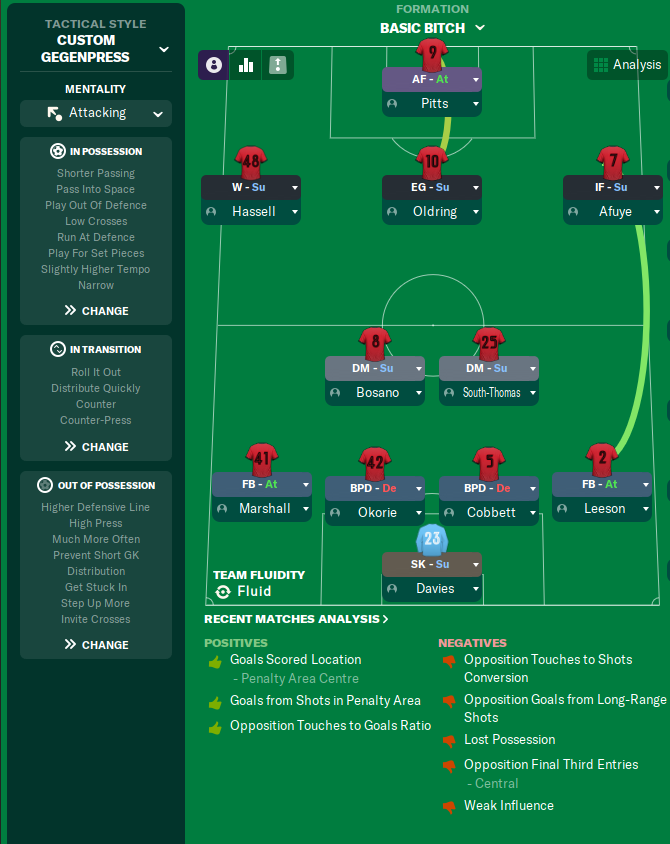
Loading tactical analysis...
Gegenpress
Attacking
4-2-3-1 Wide
Fluid
Shorter Passing
Pass Into Space
Run At Defence
Slightly Higher Tempo
Roll It Out
Distribute Quickly
Counter
Counter-Press
Higher Defensive Line
High Press
Get Stuck In
Much More Often Prevent Short GK Distribution
ST
Advanced Forward
Attack
W
Winger
Support
EG
Enganche
Support
IF
Inside Forward
Support
DM
Deep-Lying Midfielder
Support
FB
Full Back
Attack
BPD
Ball Playing Defender
Defend
SK
Sweeper Keeper
Support
The tactic generates a high number of scoring opportunities from inside the penalty area, maximizing goal conversion.
The high press and counter-press enforce mistakes from the opposition, allowing for quick recoveries of possession.
The higher defensive line might leave the team vulnerable to fast counters, especially against teams with pace.
Utilizing wingers and inside forwards could create conflicts in space management, potentially leading to congestion in the central areas.
How effective is the team at recovering possession immediately after losing it?
Are the full-backs able to contribute to both defense and attack effectively?
How often do players exploit the spaces left by opposition defenders?
What adjustments could be made if facing a counter-attacking team?
Is the Enganche role providing enough support in both attack and defense?
Are the team’s pressing triggers effective in forcing turnovers?
The tactical theory behind the 4-2-3-1 Wide: roles, instructions, and the trade-offs that decide whether the system holds up.
Klopp-style gegenpressing in FM, including squad profile, line-and-press pairing, sustainable workload, and the antipatterns to avoid.
Double pivots and flat pairs in 4-2-3-1 and 4-4-2: when each pairing works, when it collapses, and the AMC unicorn that rescues both.
Routines, takers, and target picks. How to turn corners and free-kicks into a reliable third of your goal output.











