
4-2-3-1 Wide
Combine pressing and possession play to dominate the midfield and create chances. High pressing and counter-pressing recover the ball quickly.
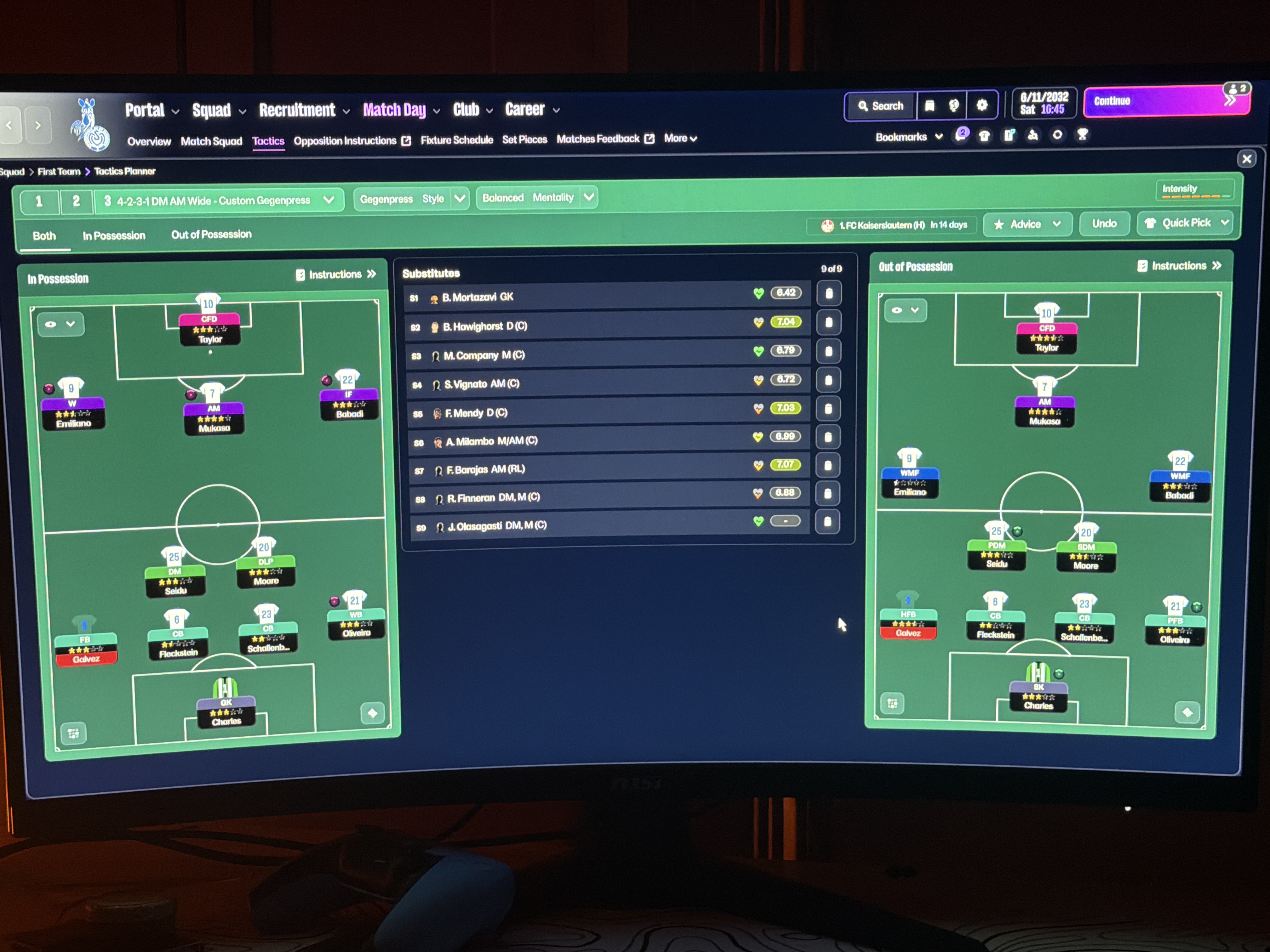
Loading tactical analysis...
Gegenpress
Balanced
4-2-3-1 Wide
Fluid
Shorter Passing
Play Out of Defence
Work Ball Into Box
Higher Tempo
Counter-Press
Counter
Higher Defensive Line
Much Higher Line of Engagement
Trigger Press More Often
Prevent Short GK Distribution
GK
Goalkeeper
De
DL
Wing-Back
At
DC
Ball-Playing Defender
De
DC
Ball-Playing Defender
De
DR
Wing-Back
At
DM
Deep-Lying Playmaker
De
CM
Central Midfielder
Su
CM
Central Midfielder
Su
AM
Inside Forward
At
AM
Advanced Playmaker
Su
ST
Pressing Forward
At
Utilizes width from wing-backs and inside forwards to create goal-scoring opportunities while controlling possession.
Engages in a rapid counter-press to recover possession quickly after losing the ball.
Combine pressing and possession play to dominate the midfield and create chances.
Compact 4-4-2
Defensive line stays compact with midfielders tracking back to support defense.
Wing-Backs contribute to both attack and defense, with higher line engagement to restrict opposing plays.
Expansive 4-2-3-1
Wide players stretching the opposition and creating space for central attackers.
Inside forwards cutting in from the flanks, supported by overlapping wing-backs.
High pressing and counter-pressing recover the ball quickly.
Pressing Forward at [6,3] and Trigger Press More Often instruction.
Fluid movement and varied roles providing options in midfield.
Advanced Playmaker at [5,3] and Central Midfielders at [4,2] & [4,4].
Team may struggle against teams who play a low block and counter effectively.
Higher Defensive Line may expose back line against fast attackers.
Heavy reliance on wing play for chances could be predictable.
Inside Forwards and Wing-Backs creating redundancy in wide areas.
Defensive Stability
Potential for exposure to counter-attacks if pressing fails.
Higher Defensive Line and trigger pressing duties indicate risk.
Injuries to Key Players
Reliance on specific players can be detrimental if injuries occur.
Key attacking roles like Inside Forward depend heavily on certain individuals.
Inside Forward and Wing-Back
Wing-backs support inside forwards creating numerical advantages.
Inside Forward at [5,2] working with the Wing-Back at [2,1].
Pressing Forward and Central Midfielders
Central midfielders can support the pressing forward quickly.
Pressing Forward at [6,3] supported by Central Midfielders at [4,2] & [4,4].
How can I improve my team's response to counter-attacks?
What adjustments can balance the reliance on wing play?
Are there alternative strategies for breaking down low-block defenses?
The tactical theory behind the 4-2-3-1 Wide: roles, instructions, and the trade-offs that decide whether the system holds up.
Klopp-style gegenpressing in FM, including squad profile, line-and-press pairing, sustainable workload, and the antipatterns to avoid.
Double pivots and flat pairs in 4-2-3-1 and 4-4-2: when each pairing works, when it collapses, and the AMC unicorn that rescues both.
Pass map, average position, xG, possession by zone: what each tablet panel tells you in FM and the tactical change it should trigger.











