
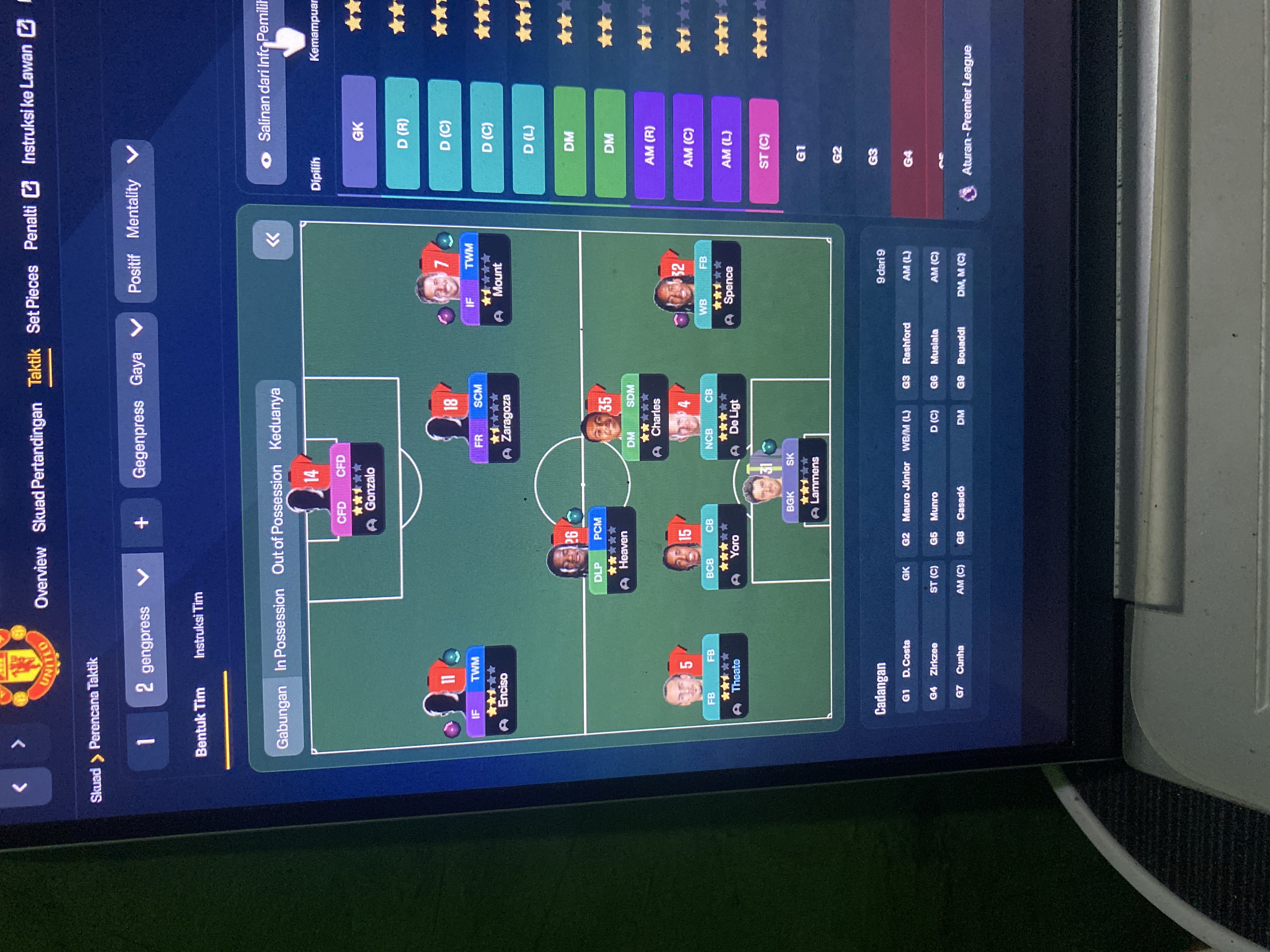
4-2-3-1 Wide
High pressing and ball recovery to initiate counter-attacks. Effective pressing to win the ball back quickly, enabling quick counter-attacks.
Loading tactical analysis...
Gegenpress
Positive
4-2-3-1 Wide
Work Ball Into Box
More Risky Passes
Counter-Press
Counter
Higher Line of Engagement
Higher Defensive Line
Trigger Press More Often
GK
Sweeper Keeper
Support
RB
Full-Back
Support
CB
No-Nonsense Centre-Back
Defend
CB
Ball-Playing Defender
Defend
LB
Wing-Back
Attack
DM
Deep-Lying Playmaker
Support
CM
Central Midfielder
Support
AM
Attacking Midfielder
Attack
AM
Inside Forward
Attack
ST
Complete Forward
Attack
Quick transitions and fluid movements aiming to create space in attacking thirds.
Immediate pressing upon losing possession.
High pressing and ball recovery to initiate counter-attacks.
Compact
Formation stays compact and presses high, maintaining defensive discipline.
Higher Line of Engagement and Trigger Press More Often.
Fluid and Dynamic
Fluid movement among front players aims to exploit gaps.
Work Ball Into Box and More Risky Passes.
Effective pressing to win the ball back quickly, enabling quick counter-attacks.
Trigger Press More Often and Counter-Press.
Dynamic front line that interchanges positions and creates multiple threats.
Inside Forward and Attacking Midfielder roles.
High pressing and advanced positioning may leave gaps in defense if the counter-press fails.
Higher Line of Engagement may lead to vulnerabilities.
Dependence on wing play with high attacking full-backs may create spaces for opposition counters.
Wing-Back role at [2,5] pushing forward.
Wide Spaces
Vulnerabilities on flanks due to high wing-backs.
Wing-Back role at [2,5] and [2,1].
Midfield Control
Risk of losing control in midfield during transitions.
Advanced midfielders could get caught out of position.
Deep-Lying Playmaker + Central Midfielder
Together they provide balance between attack and defense.
DLP-S at [3,3] and CM-S at [4,3] offer stability.
Wing-Back + Inside Forward
Creates space and overloads, allowing wide attacks to be effective.
FB-S at [2,1] and IF-A at [5,1].
How can the team improve its defensive stability while maintaining pressing effectiveness?
What adjustments can be made to exploit the opponent's weaknesses in midfield?
Are there specific match scenarios where a tactical switch might be beneficial?
The tactical theory behind the 4-2-3-1 Wide: roles, instructions, and the trade-offs that decide whether the system holds up.
Klopp-style gegenpressing in FM, including squad profile, line-and-press pairing, sustainable workload, and the antipatterns to avoid.
Double pivots and flat pairs in 4-2-3-1 and 4-4-2: when each pairing works, when it collapses, and the AMC unicorn that rescues both.
Build through the wide areas or through the middle? A working framework for picking the right one for your squad.











