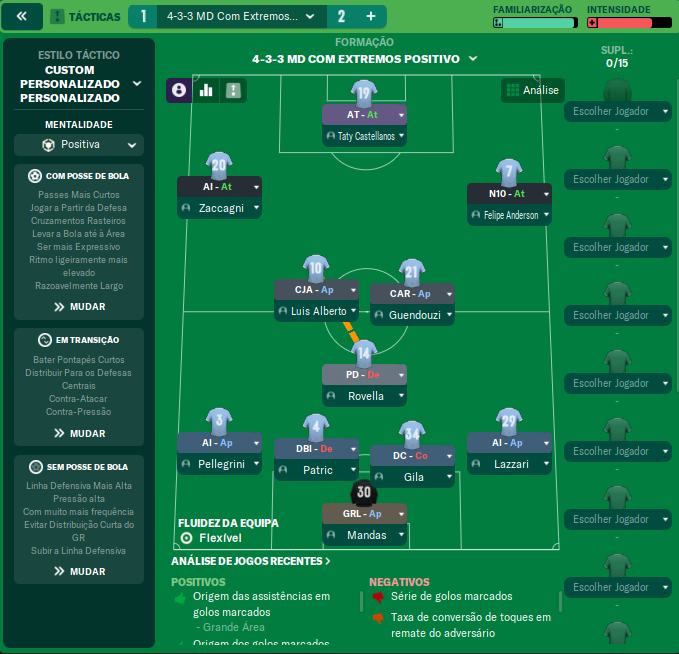
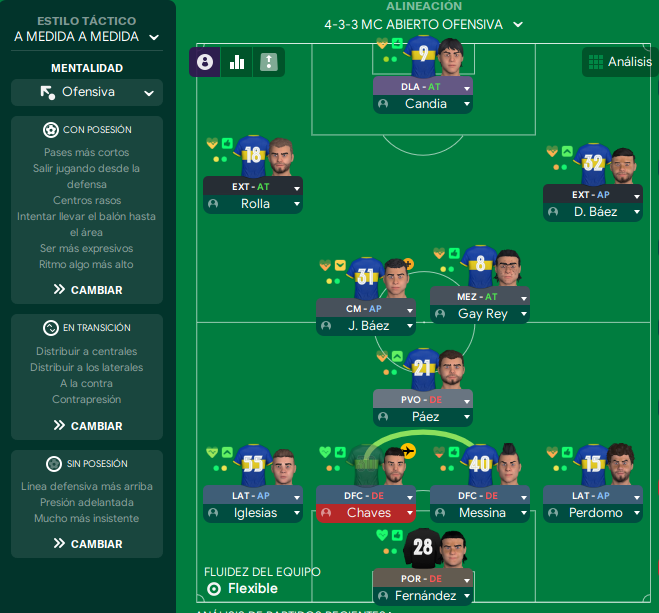
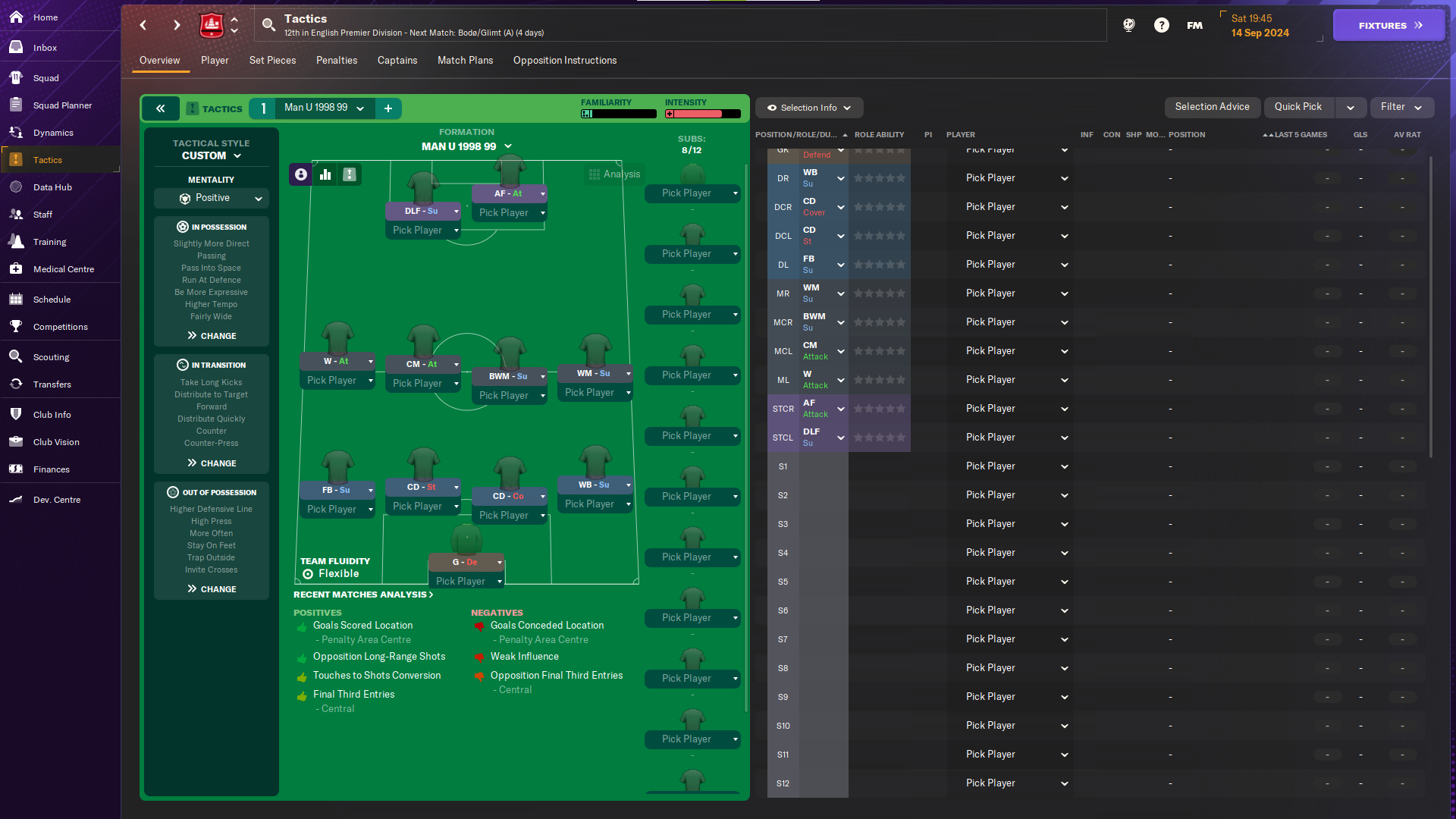
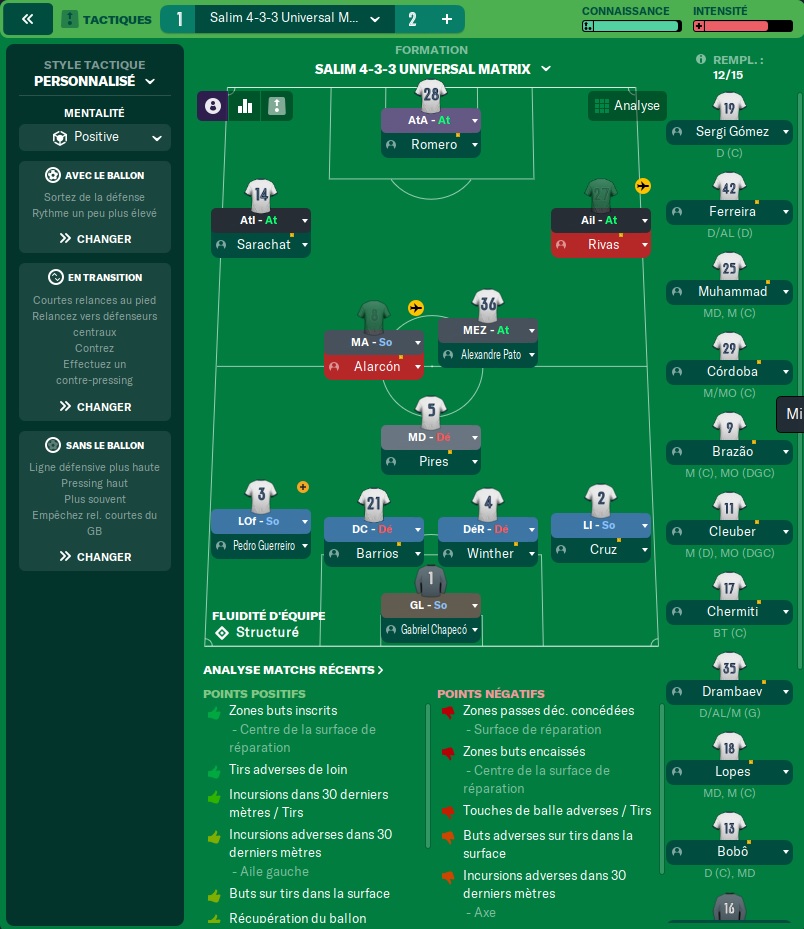
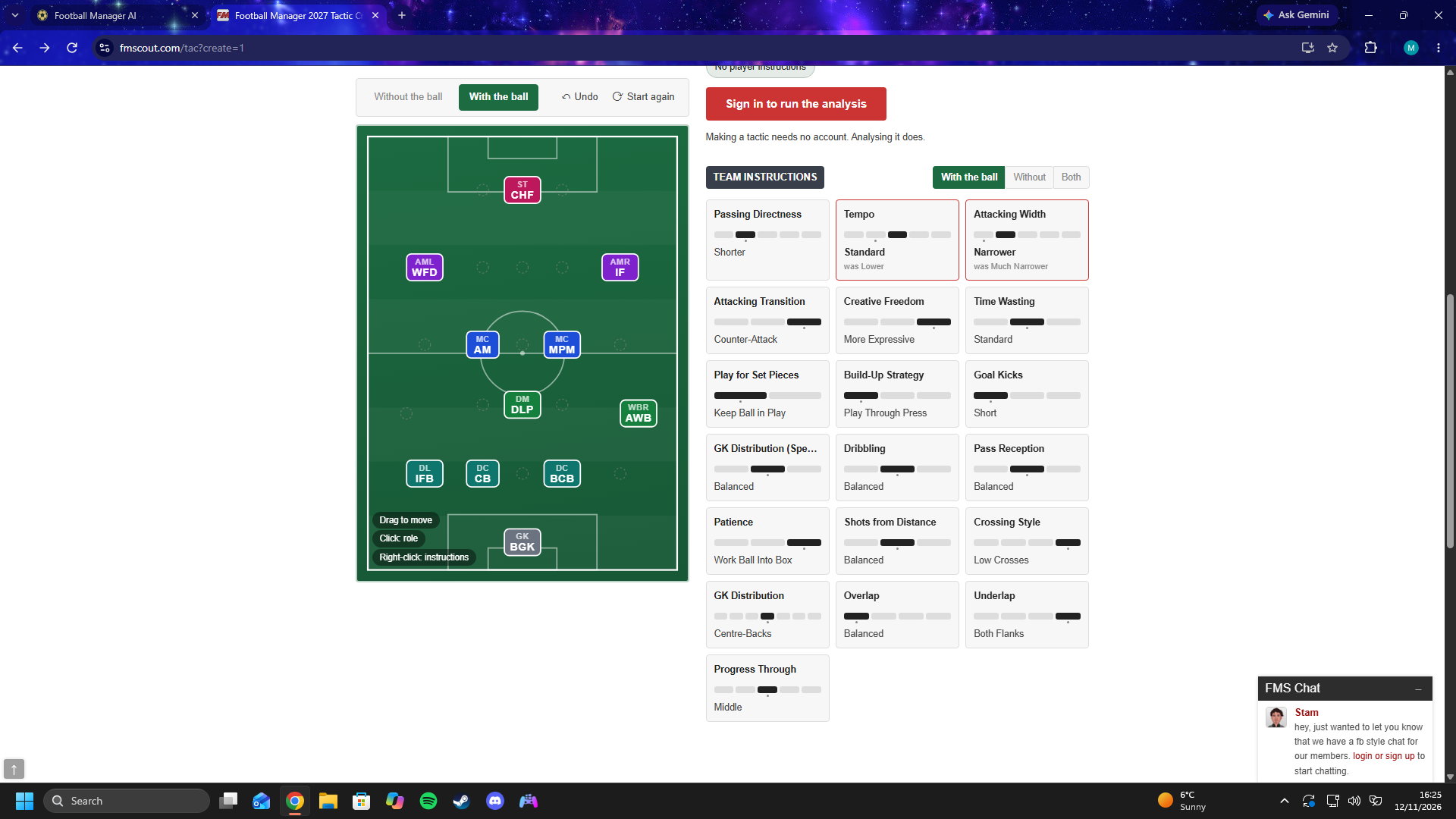
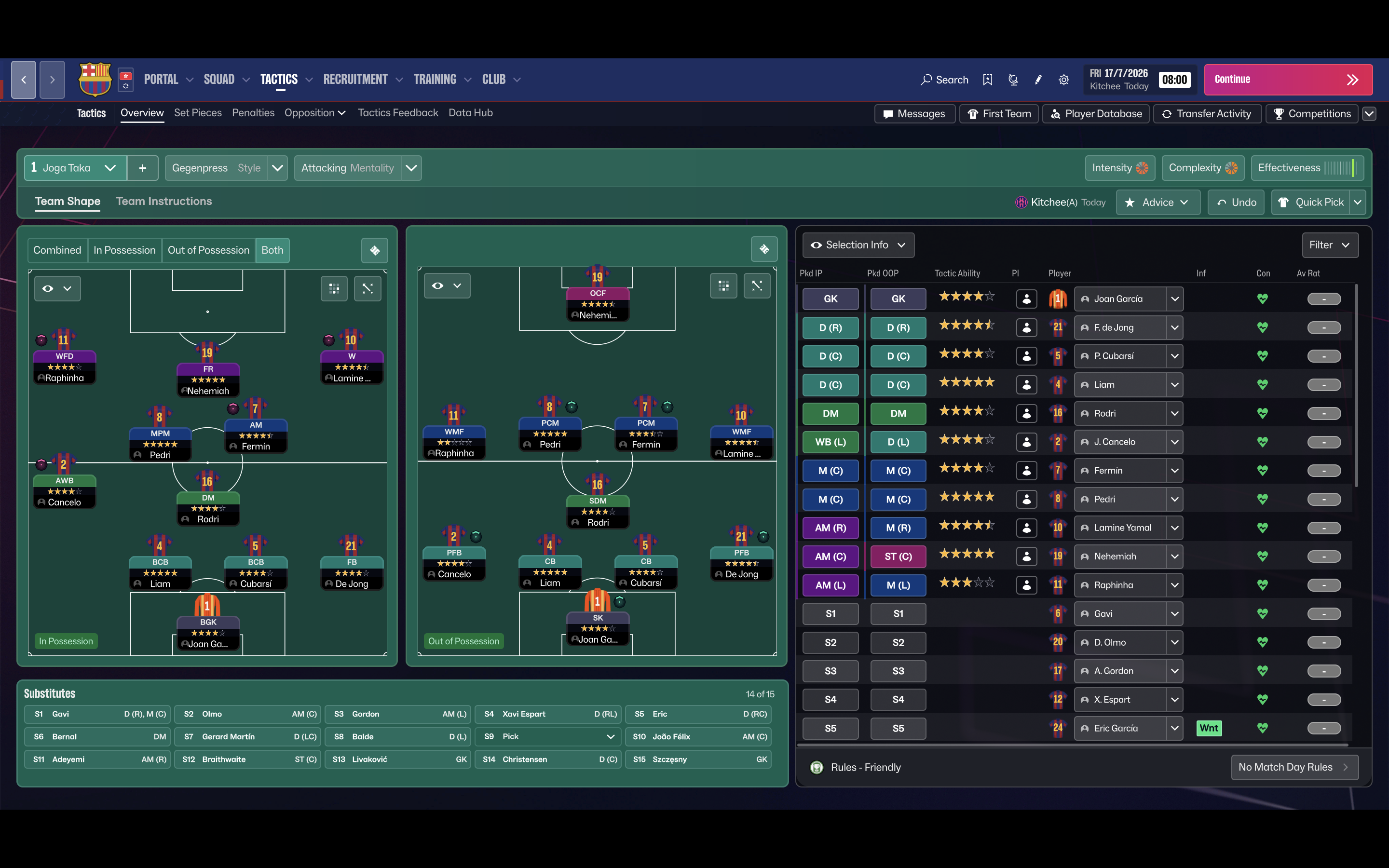
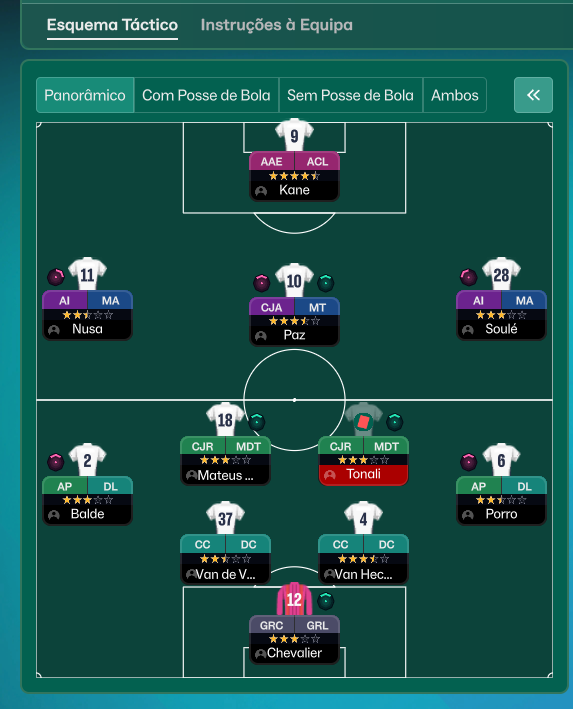
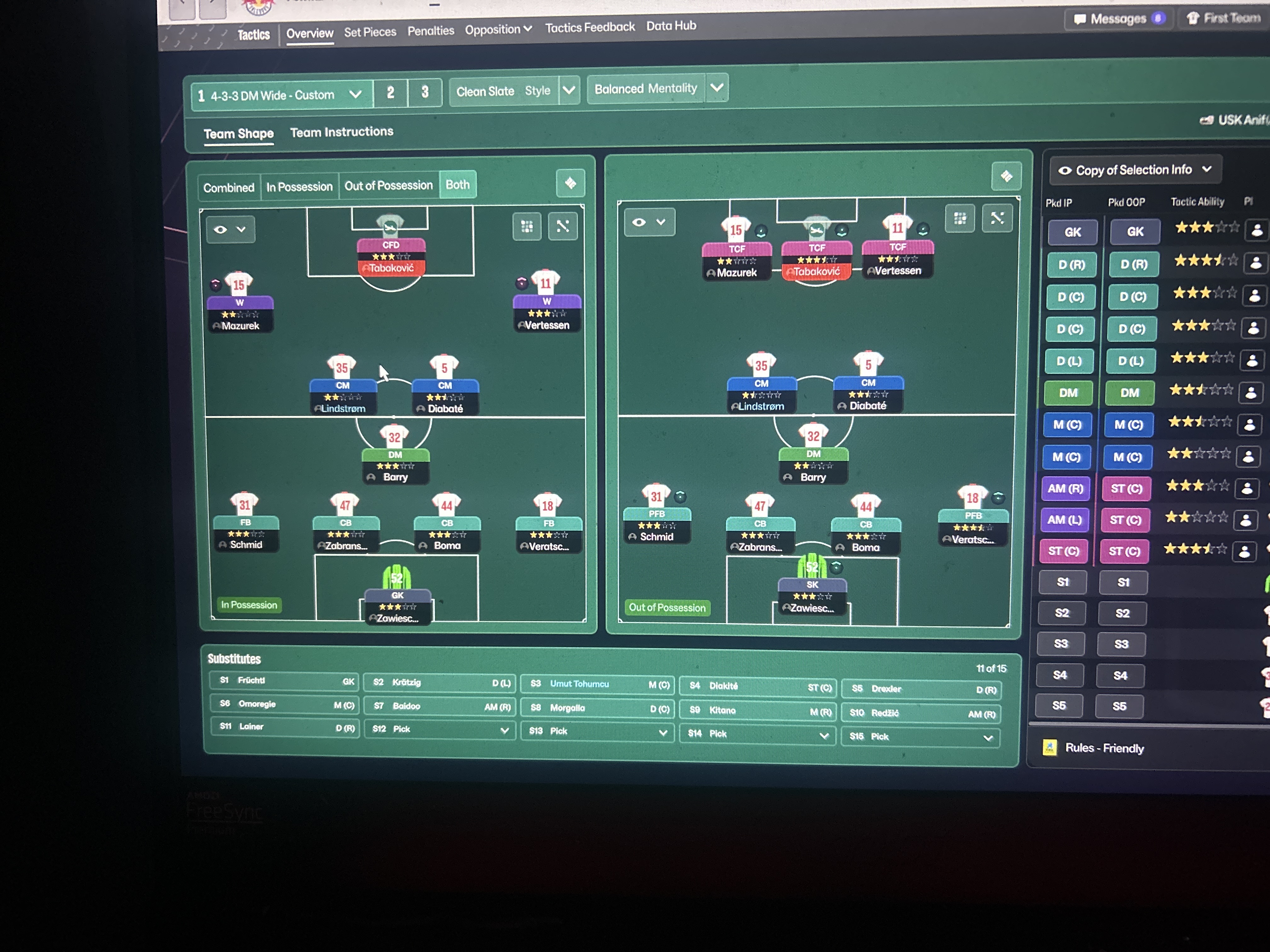
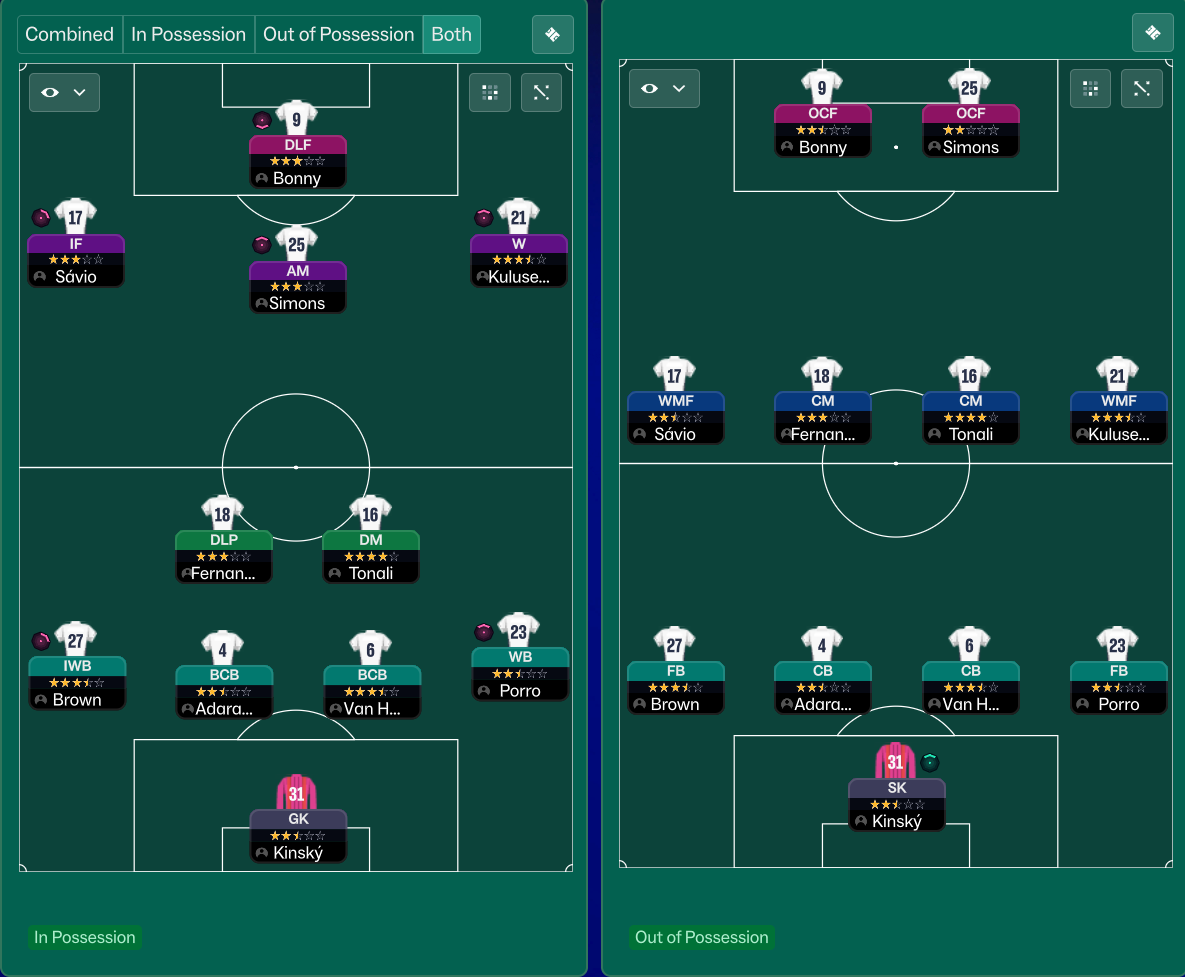
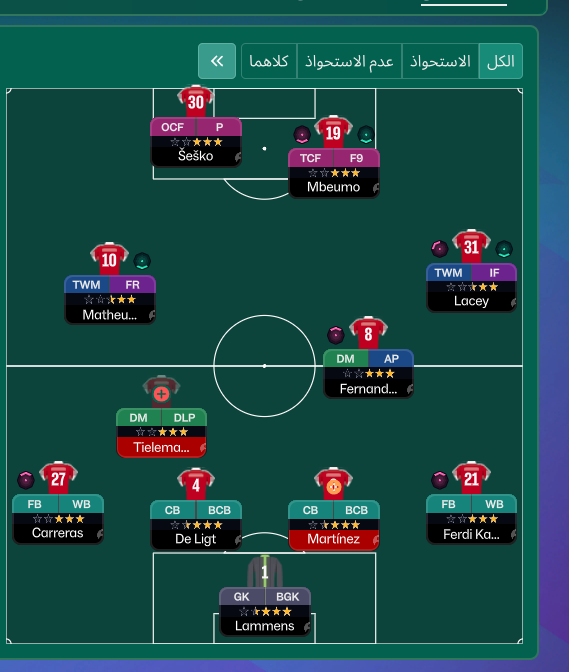
4-3-3
Maintaining possession and creating chances through intricate play. A balanced midfield that can defend, press, and control play.
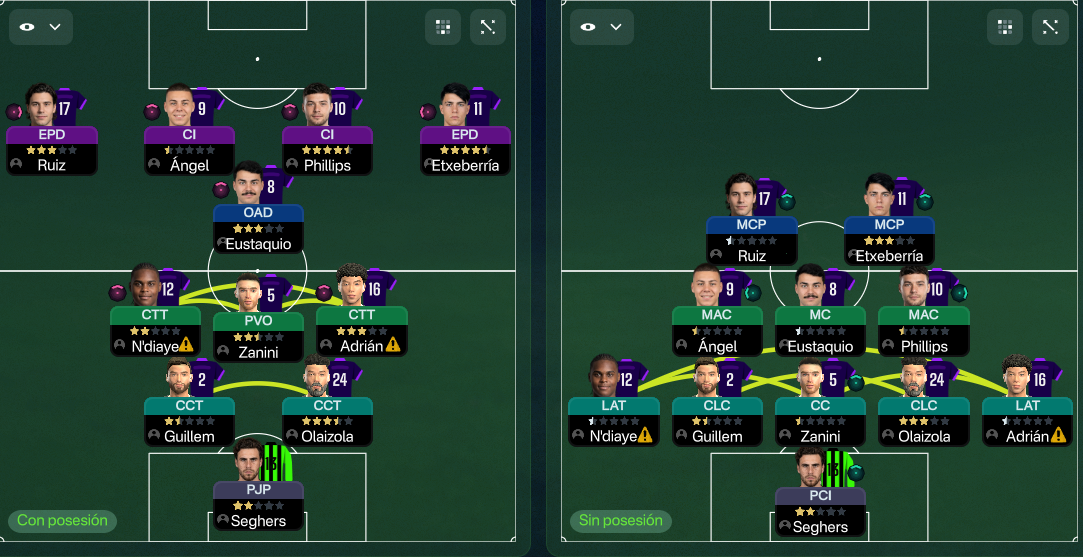
Loading tactical analysis...
Possession
Positive
4-3-3
Structured
Play Out of Defence
Focus Play Through the Middle
Shorter Passing
Work Ball into Box
Counter Press
Counter
Higher Defensive Line
Higher Line of Engagement
Prevent Short GK Distribution
Trigger Press More Often
GK
Goalkeeper
Defend
CB
Central Defender
Defend
CB
Central Defender
Defend
LB
Wing-Back
Attack
RB
Wing-Back
Attack
CM
Deep-Lying Playmaker
Support
CM
Ball-Winning Midfielder
Support
CM
Central Midfielder
Support
LW
Inside Forward
Attack
RW
Inside Forward
Attack
ST
Advanced Forward
Attack
Focus on maintaining ball control and patient build-up through short passes, utilizing the width from wing-backs.
Quickly regroup and press to win the ball back, utilizing high engagement.
Maintaining possession and creating chances through intricate play.
Compact 4-4-2
The defensive shape is compact, with a solid line of four defenders and support from midfielders.
Defensive setup features two banks of four with midfielders dropping in.
Fluid 4-3-3
In attack, the shape becomes fluid, with players exchanging positions and utilizing width.
Inside forwards cutting in, wing-backs overlapping to maintain width.
A balanced midfield that can defend, press, and control play.
DLP-S at [3,3], BWM-S at [3,2], CM-S at [3,1]
Wing-backs provide width, while inside forwards create goal-scoring opportunities.
WB-A at [2,1], WB-A at [2,5]
Overcommitting players forward may expose the defense during transitions.
High line and aggressive pressing may leave gaps.
With advanced roles, there's a risk of overcrowding in certain areas.
Midfield trio may struggle for space.
Defensive Setup
High defensive line may lead to vulnerabilities against fast counter-attacks.
High line of engagement coupled with pressing.
Midfield Density
A crowded midfield can lead to limited options when transitioning to attack.
Three midfielders may overcrowd central areas.
DLP-S and BWM-S
Creates a balanced dynamic allowing for both possession retention and pressing.
DLP-S at [3,3] combined with BWM-S at [3,2].
Wing-Backs and Inside Forwards
Allows for overlapping runs and creates space for attacking moves.
WB-A at [2,1] with IF-A at [6,2] and [6,4].
How can we improve defensive cover during counter-attacks?
Are there specific players that fit better into our tactical philosophy?
What adjustments can be made to enhance our attacking fluidity?
The tactical theory behind the 4-3-3: roles, instructions, and the trade-offs that decide whether the system holds up.
Klopp-style gegenpressing in FM, including squad profile, line-and-press pairing, sustainable workload, and the antipatterns to avoid.
Why circulation density and zonal occupation aren't the same thing in FM, and the half-space occupation rule that decides build-up.
The pairing rule for Defensive Line and Line of Engagement, all 9 combinations, and the gap that costs goals.