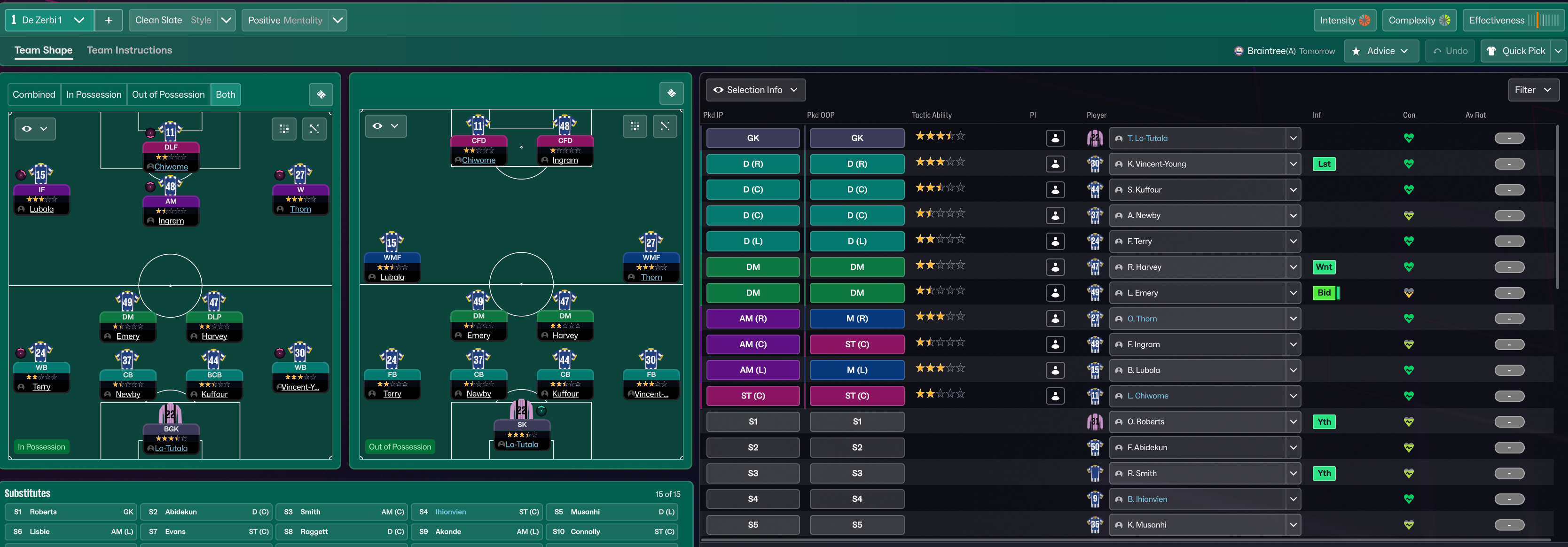
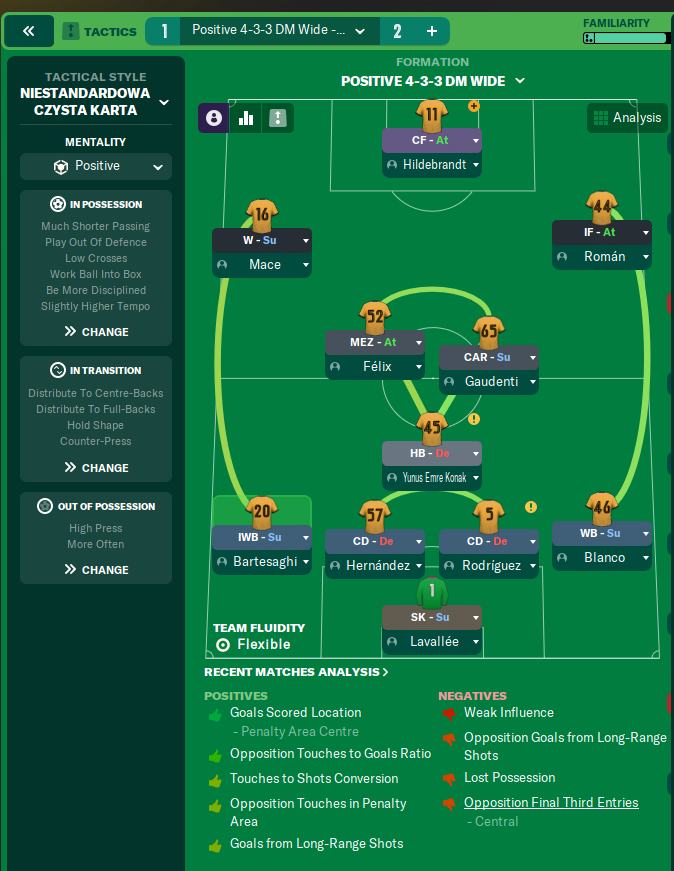
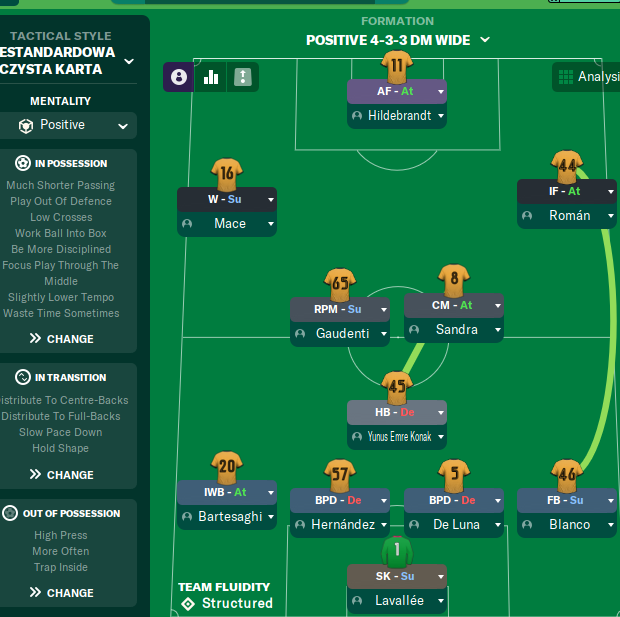
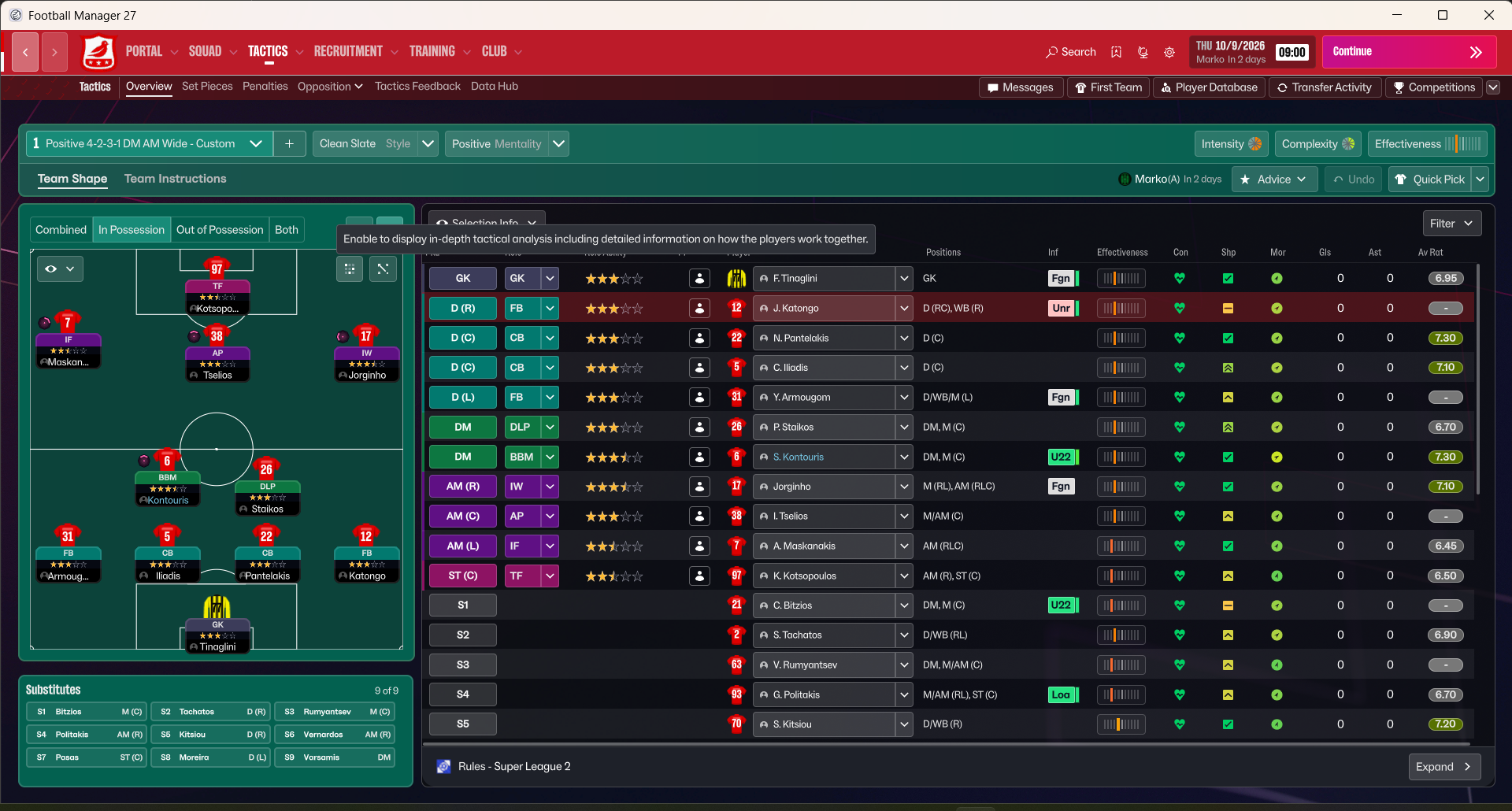
4-2-3-1 Wide
Dominating the midfield and exploiting width. The combination of a BWM and DLP in central areas allows for control and stability.
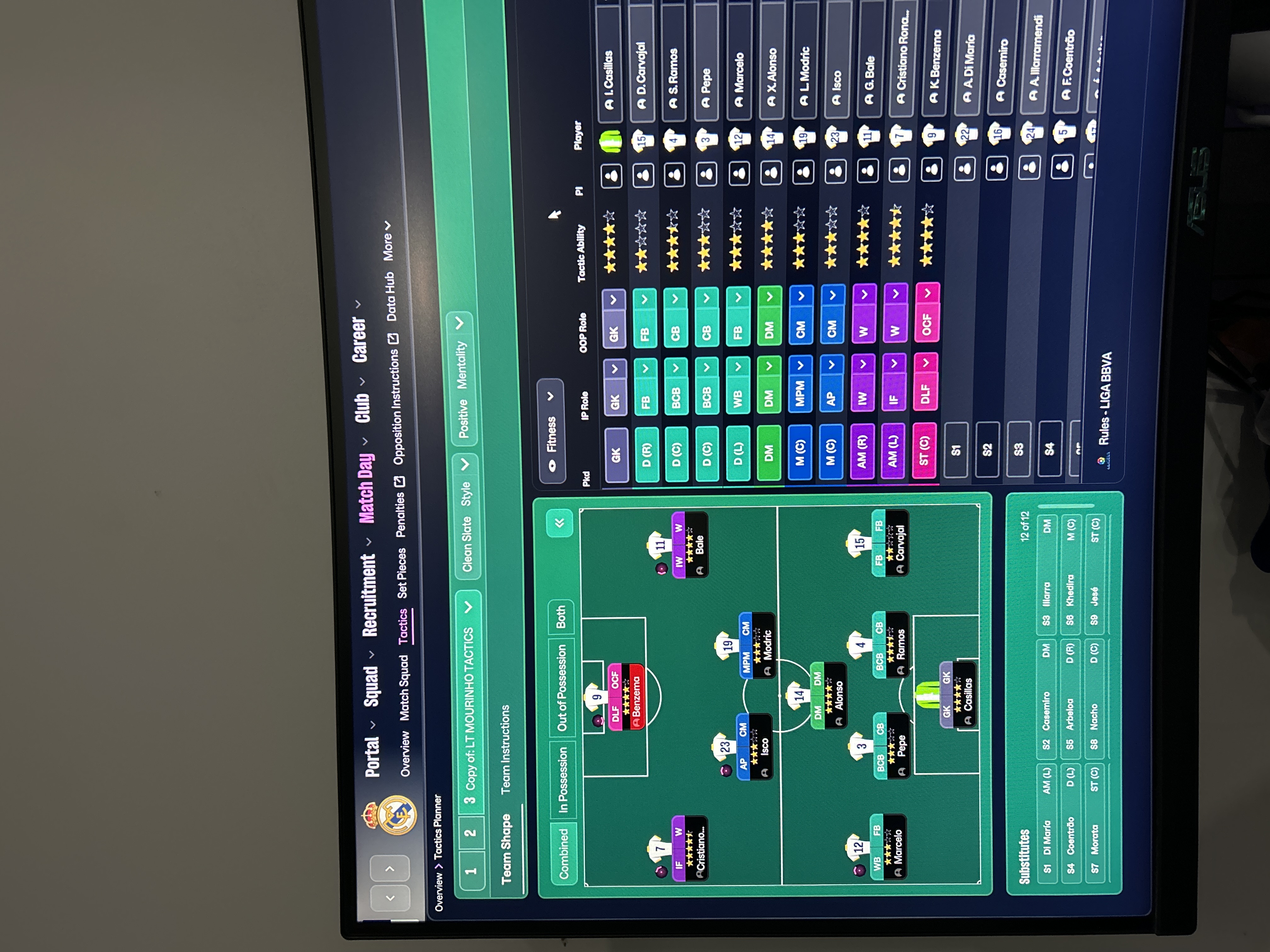
Loading tactical analysis...
Positive
Positive
4-2-3-1 Wide
Play Out of Defence
Work Ball into Box
Focus Play Through Middle
Higher Tempo
Counter-Press
Counter
Higher Defensive Line
Higher Line of Engagement
Prevent Short GK Distribution
GK
G
DL
FB
Su
DC
CB
De
DC
CB
De
DR
FB
Su
DM
BWM
De
DM
DLP
Su
AM
AP
Su
AM
WM
At
AM
WM
At
ST
DLF
Su
Focuses on quick transitions and utilizing wingers to create space.
Quickly regains possession through counter-pressing.
Dominating the midfield and exploiting width.
Compact
Maintains a strong compact shape to limit opposition space.
Higher Defensive Line and Higher Line of Engagement push players up the pitch.
Fluid
Utilizes wingers and an advanced playmaker to attack through central and wide areas.
Focus Play Through Middle and Work Ball into Box facilitate fluid attacking.
The combination of a BWM and DLP in central areas allows for control and stability.
BWM at [3,3] and DLP at [3,4] facilitate transition play.
Wingers provide width and attacking options near the flanks.
WMs at [5,2] and [5,4] stretch the opposition's defense.
Full-backs pushing high may leave gaps defensively.
FBs at [2,1] and [2,5] could be exposed if possession is lost quickly.
Heavy reliance on wingers may limit central attacking options.
Focus Play Through Middle with WMs could lead to central congestion.
Defensive Exhaustion
Frequent pressing may lead to fatigue in defensive players.
Higher tempo combined with Counter-Press is demanding.
Counter-Attack Vulnerability
With a higher defensive line, counter-attacks can exploit spaces behind.
Higher Line of Engagement puts defenders further up the pitch.
BWM and DLP
Strong combination in midfield facilitates both defence and transition.
BWM at [3,3] and DLP at [3,4] work cohesively.
Wingers with DLF
Wingers can provide crucial support to the deep-lying forward.
WMs at [5,2] and [5,4] look for overlaps with DLF at [6,3].
How can we better utilize the wide areas in attacking phases?
What adjustments can we make to minimize risk during counter-attacks?
Should we consider altering player roles to better fit our strategy?
The tactical theory behind the 4-2-3-1 Wide: roles, instructions, and the trade-offs that decide whether the system holds up.
Double pivots and flat pairs in 4-2-3-1 and 4-4-2: when each pairing works, when it collapses, and the AMC unicorn that rescues both.
Klopp-style gegenpressing in FM, including squad profile, line-and-press pairing, sustainable workload, and the antipatterns to avoid.
Counter-Press, Regroup, Stand Off, Trigger Press: what each pressing instruction does in FM and how to pair them without contradicting.