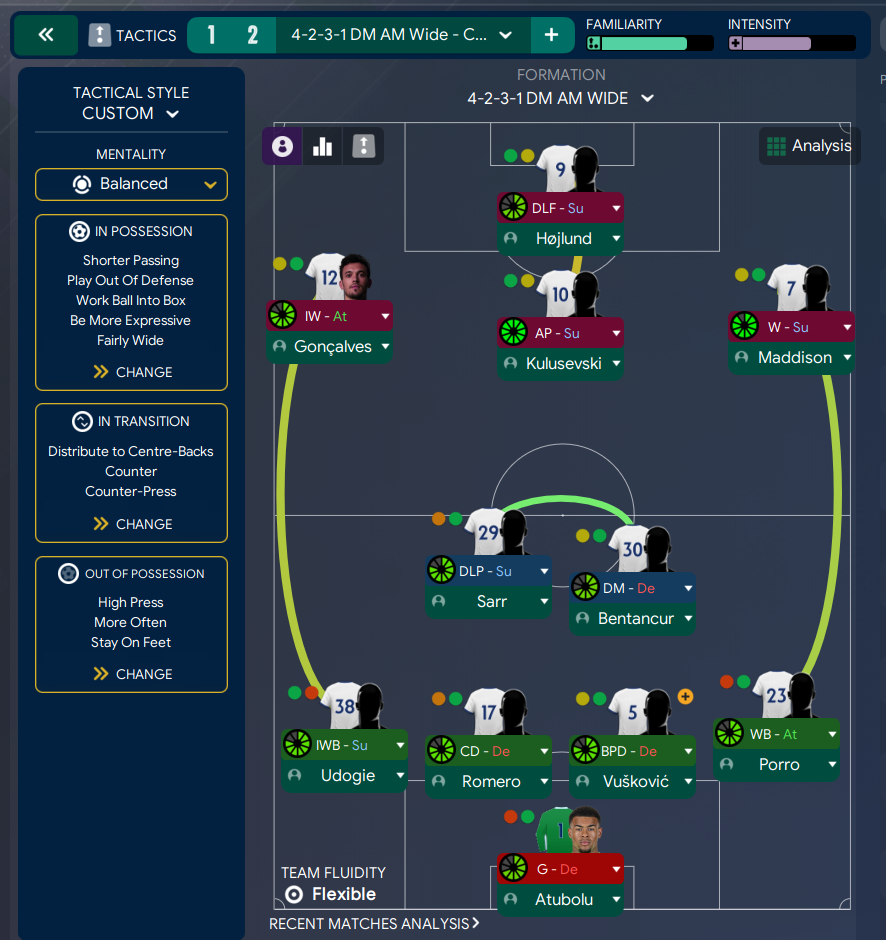
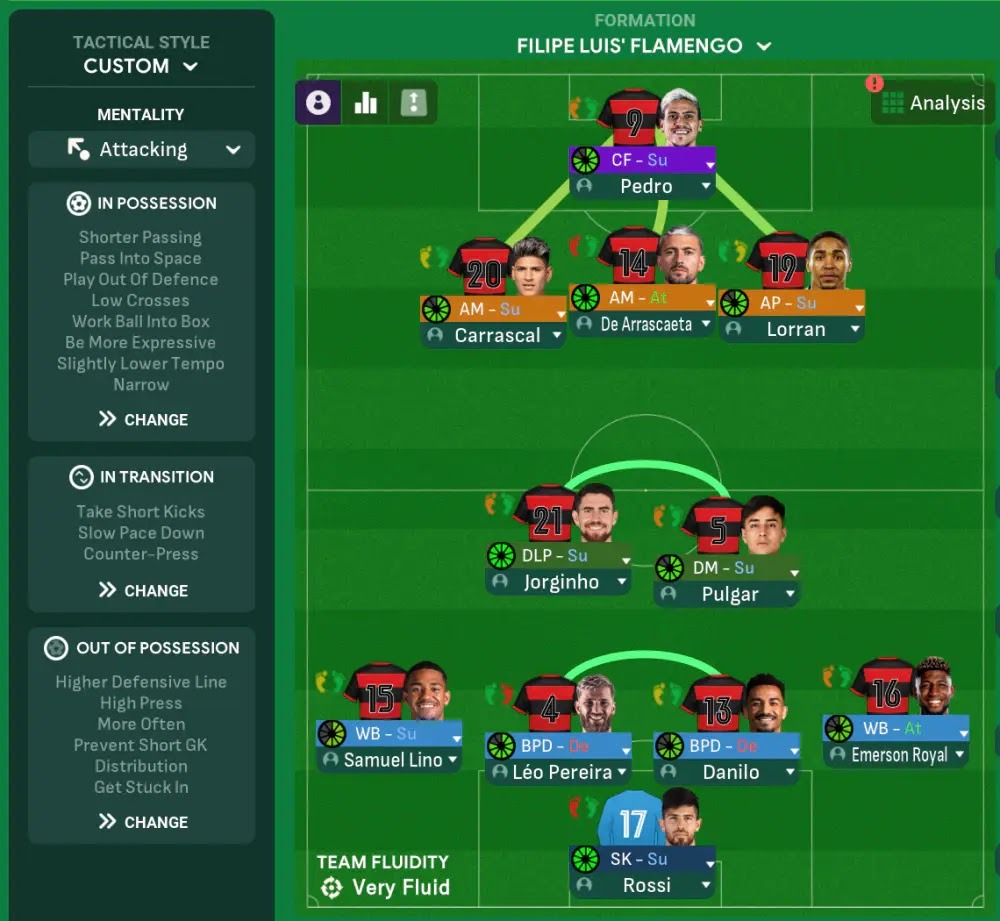
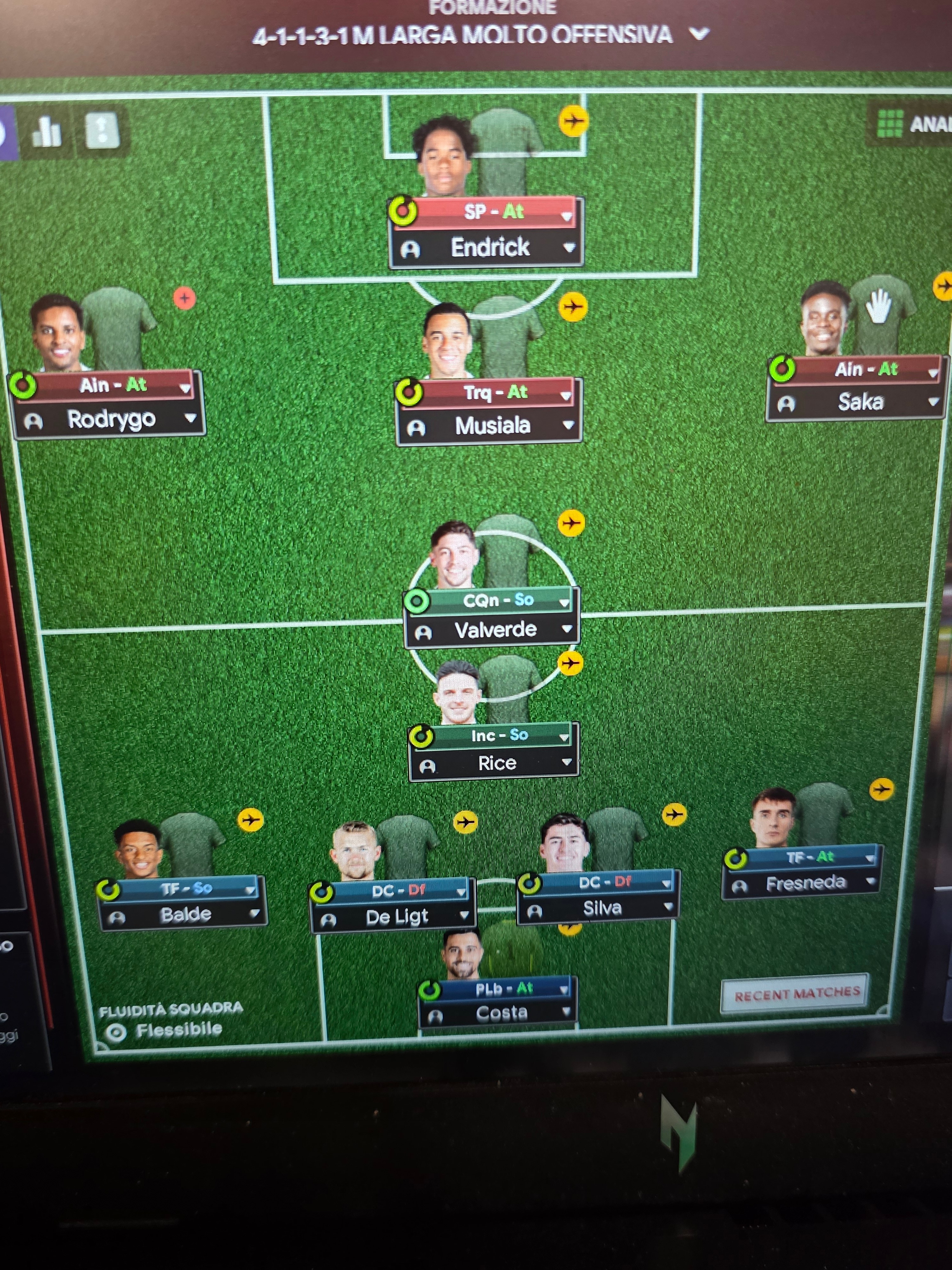
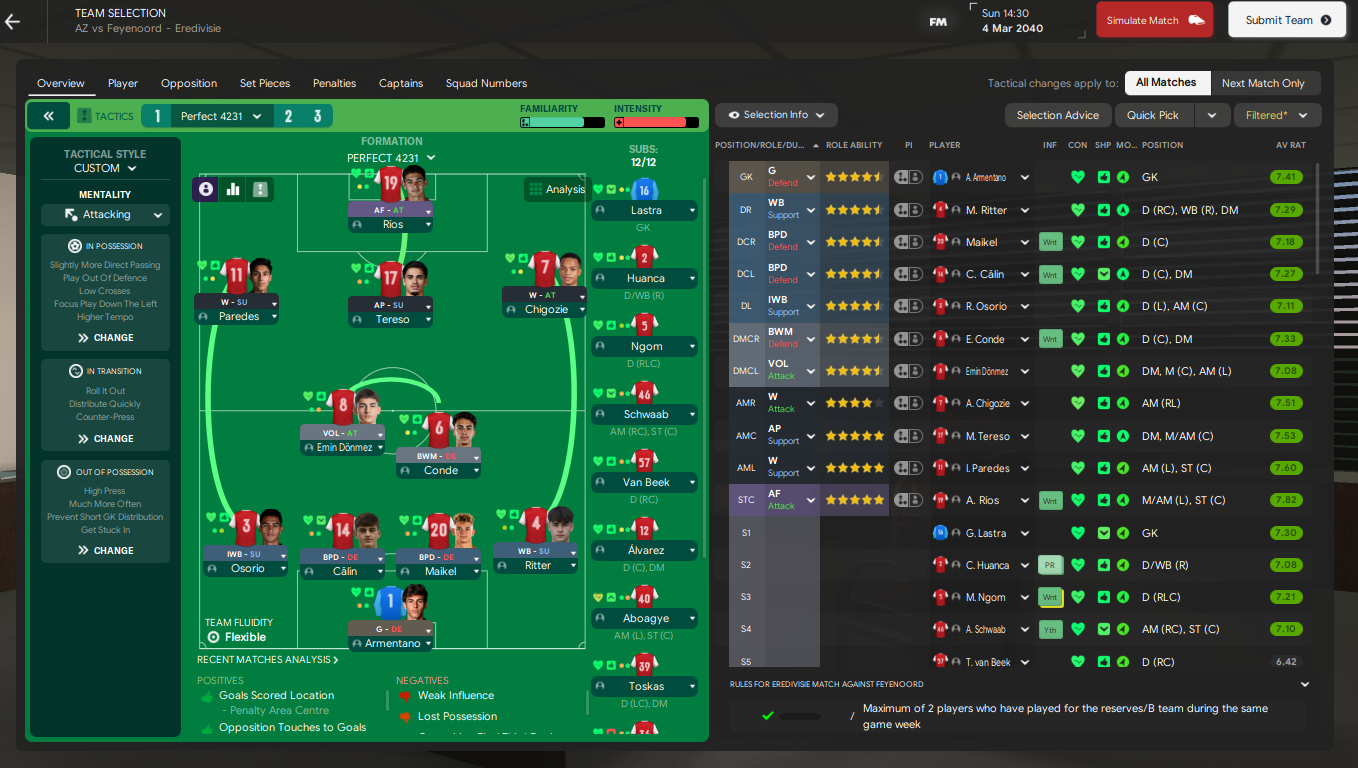
4-2-3-1
Exploit central areas while maintaining width to stretch opponents. Players can change positions seamlessly, making defensive setups difficult to maintain.
Loading tactical analysis...
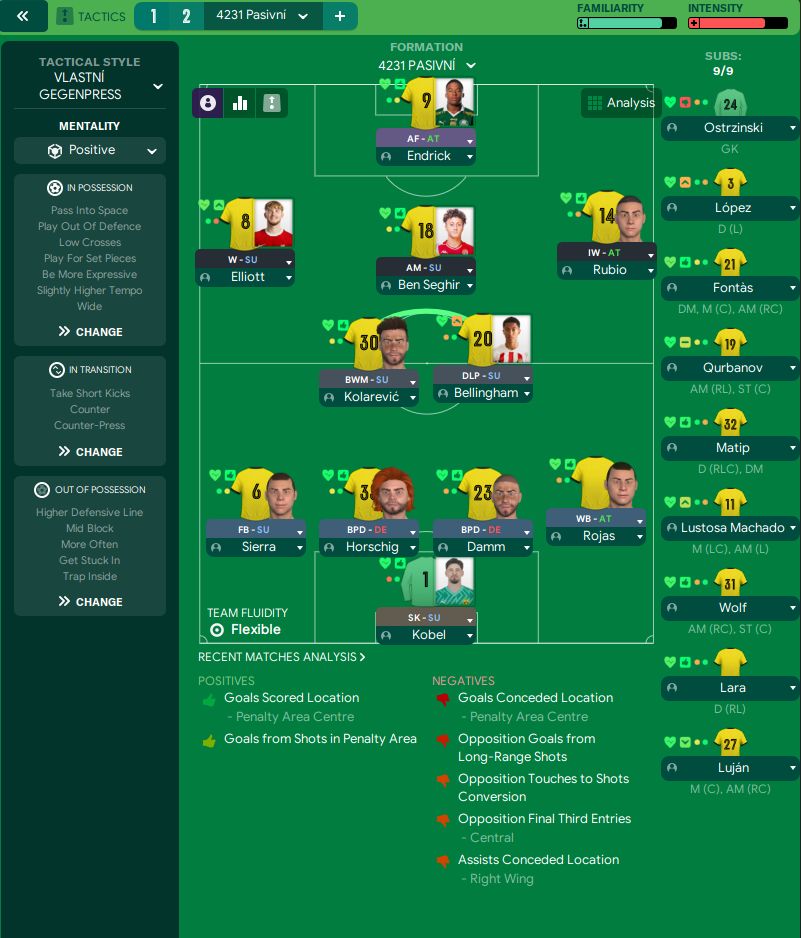
Gegenpress
Positive
4-2-3-1
Flexible
Pass Into Space
Play Out of Defence
Low Crosses
Be More Expressive
Slightly Higher Tempo
Wide
Take Short Kicks
Counter
Counter-Press
Higher Defensive Line
Mid Block
More Often
Get Stuck In
Trap Inside
GK
Sweeper Keeper
Support
Defence
Full-Back
Support
Defence
Ball-Playing Defender
Defend
Defence
Full-Back
Attack
Defensive Midfield
Ball-Winning Midfielder
Support
Central Midfield
Deep-Lying Playmaker
Support
Attacking Midfield
Attacking Midfielder
Attack
Attacking Midfield
Inside Winger
Attack
Attacking Midfield
Advanced Forward
Attack
Utilizing width with overlapping full-backs and inside forwards creating space in the final third.
Quick transition to regain possession through counter-pressing.
Exploit central areas while maintaining width to stretch opponents.
Mid Block
The team adopts a mid block to contain space and win the ball back quickly.
Higher Defensive Line and Trap Inside help contain and direct opposition play.
Fluid 4-2-3-1
Attacking players interchange positions to confuse defenders and overload key zones.
Use of Inside Winger and Attacking Midfielder roles to create mismatches in the opponent's defensive structure.
Players can change positions seamlessly, making defensive setups difficult to maintain.
Inside Winger (Rubio) at [5,4] and Attacking Midfielder (Ben Seghir) at [5,3] demonstrate this.
Counter-press tactics can suffocate opposition build-up play.
Counter-Press and higher defensive line directives align with a compact formation.
Exposes central areas during transitions.
Deep-Lying Playmaker (Bellingham) at [4,3] may become isolated under quick opposition transitions.
Can lead to defenders being exposed to pacey counter-attacks.
Mid Block coupled with Higher Defensive Line may lead to gaps.
Defensive Transition
Quick opposition counter-attacks can exploit the transition phase.
Counter-Press may lead to gaps if possession is lost.
Central Defense
Central defenders might struggle against fast attackers.
Ball-Playing Defender (Horschig) might step up, leaving space behind.
Inside Winger (Rubio) and Full-Back (Sierra)
Overlap provides width while attacking.
Full-Back (Sierra) at [2,1] supports inside movements of Winger (Rubio) at [5,5].
Ball-Winning Midfielder (Kolarević) and Deep-Lying Playmaker (Bellingham)
Partnership balances defensive work and creativity.
BWM-S at [4,2] supports other midfielders and helps reclaim possession.
How can defensive organization be improved against counter-attacks?
What adjustments can be made to enhance central midfield control?
How can set pieces be more effectively utilized in future matches?
The tactical theory behind the 4-2-3-1: roles, instructions, and the trade-offs that decide whether the system holds up.
Double pivots and flat pairs in 4-2-3-1 and 4-4-2: when each pairing works, when it collapses, and the AMC unicorn that rescues both.
Klopp-style gegenpressing in FM, including squad profile, line-and-press pairing, sustainable workload, and the antipatterns to avoid.
What Higher Tempo, Wider, and Narrower actually do in FM, plus the dial contradictions and antipatterns players run into most often.