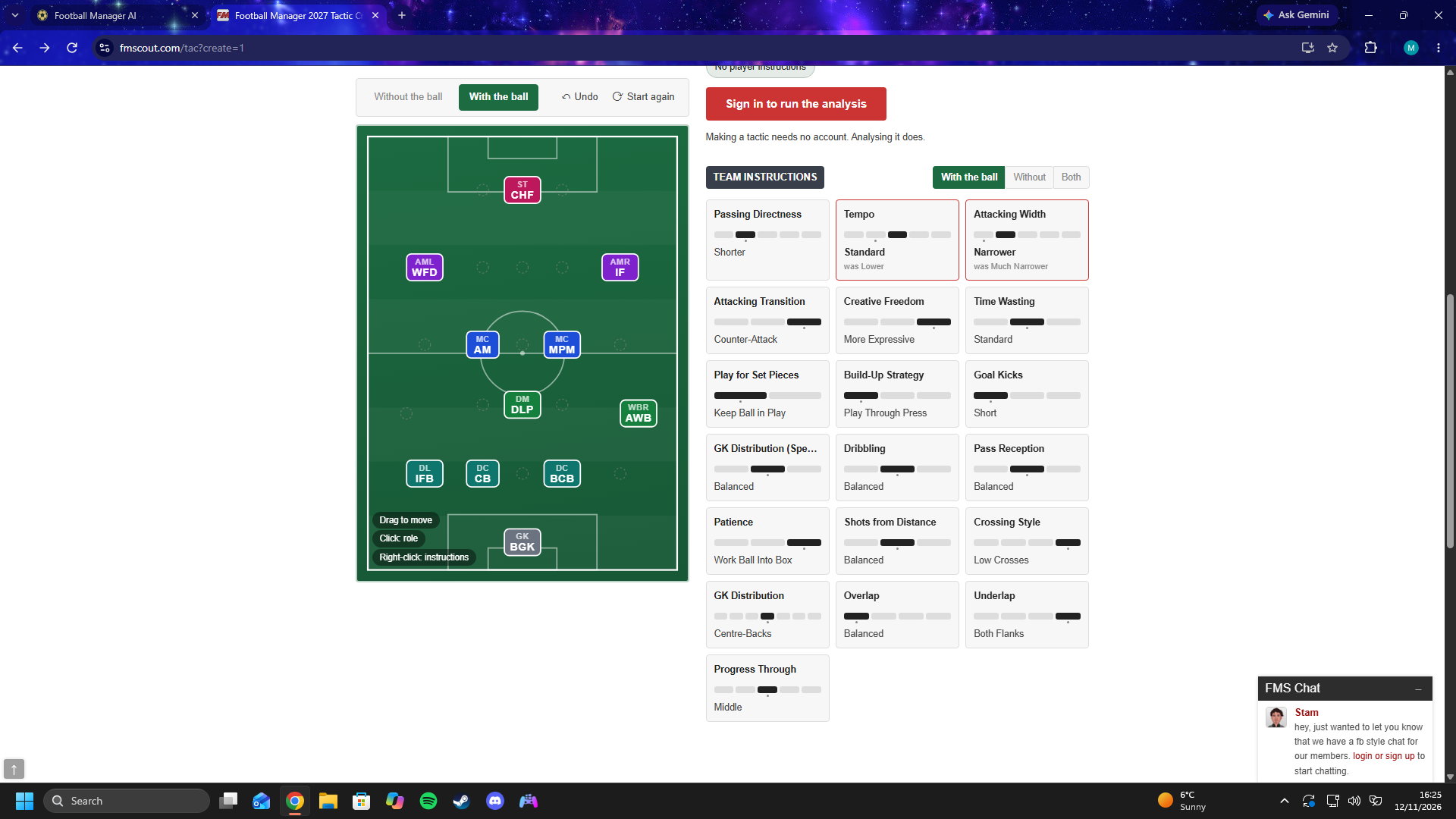
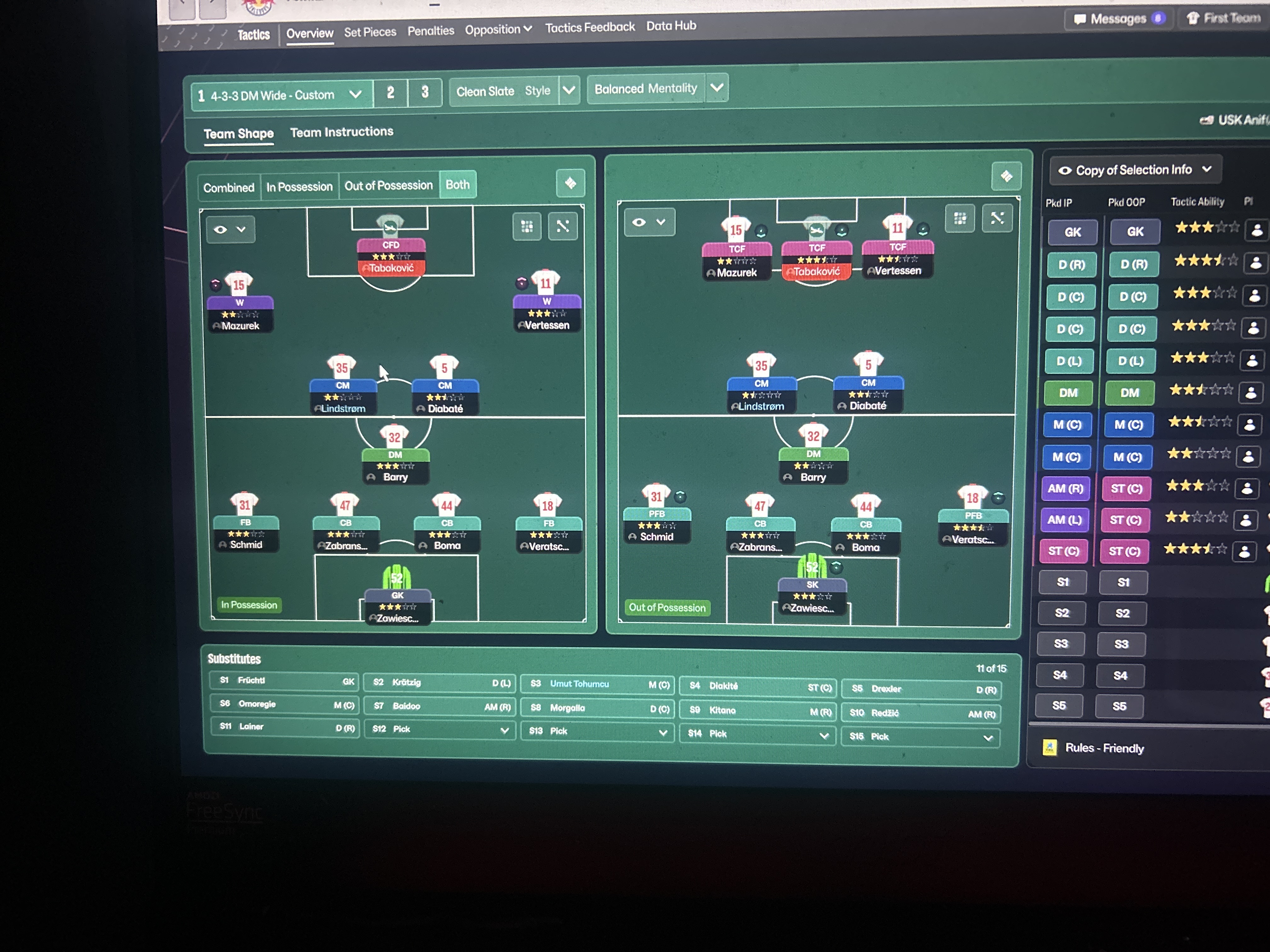
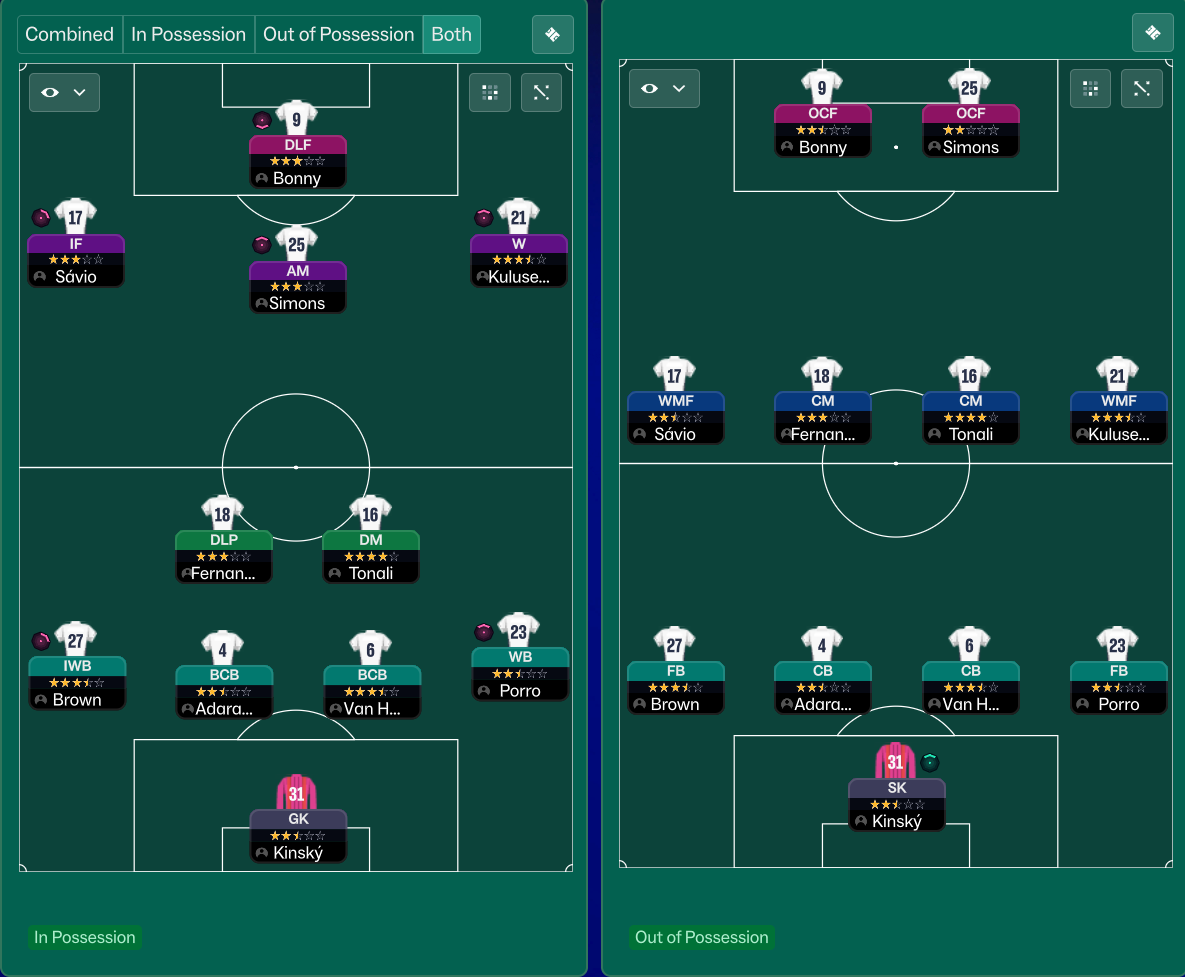
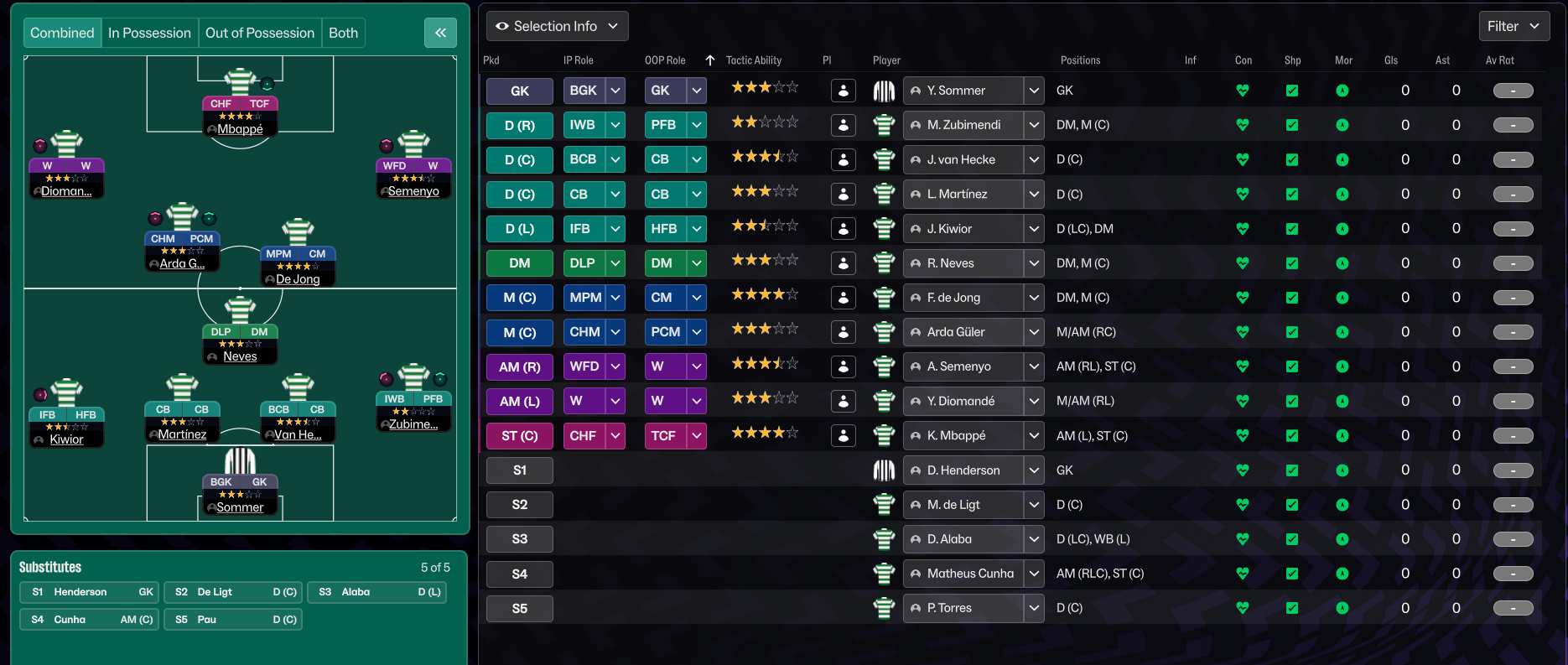
4-2-3-1 Wide
Attacking through the wide areas while maintaining control in midfield. Effective use of wing-backs creates space and stretches opposition.
Loading tactical analysis...
Possession
Attacking
4-2-3-1 Wide
Fluid
Play Out of Defence
Higher Tempo
Work Ball into Box
Pass Into Space
Counter-Press
Counter
Much Higher Defensive Line
Higher Line of Engagement
Prevent Short GK Distribution
Trigger Press More Often
GK
Goalkeeper
De
RB
Wing-Back
At
CB
Ball-Playing Defender
De
CB
Ball-Playing Defender
De
LB
Wing-Back
At
CM
Mezzala
Su
CM
Central Midfielder
Su
AM
Shadow Striker
At
RW
Winger
At
LW
Winger
At
Utilizing width through wing-backs and exploiting spaces with quick passing.
Engaging opponents quickly to regain possession, emphasizing high press.
Attacking through the wide areas while maintaining control in midfield.
4-4-2
Compact shape restricting central lanes, but can expose wide areas.
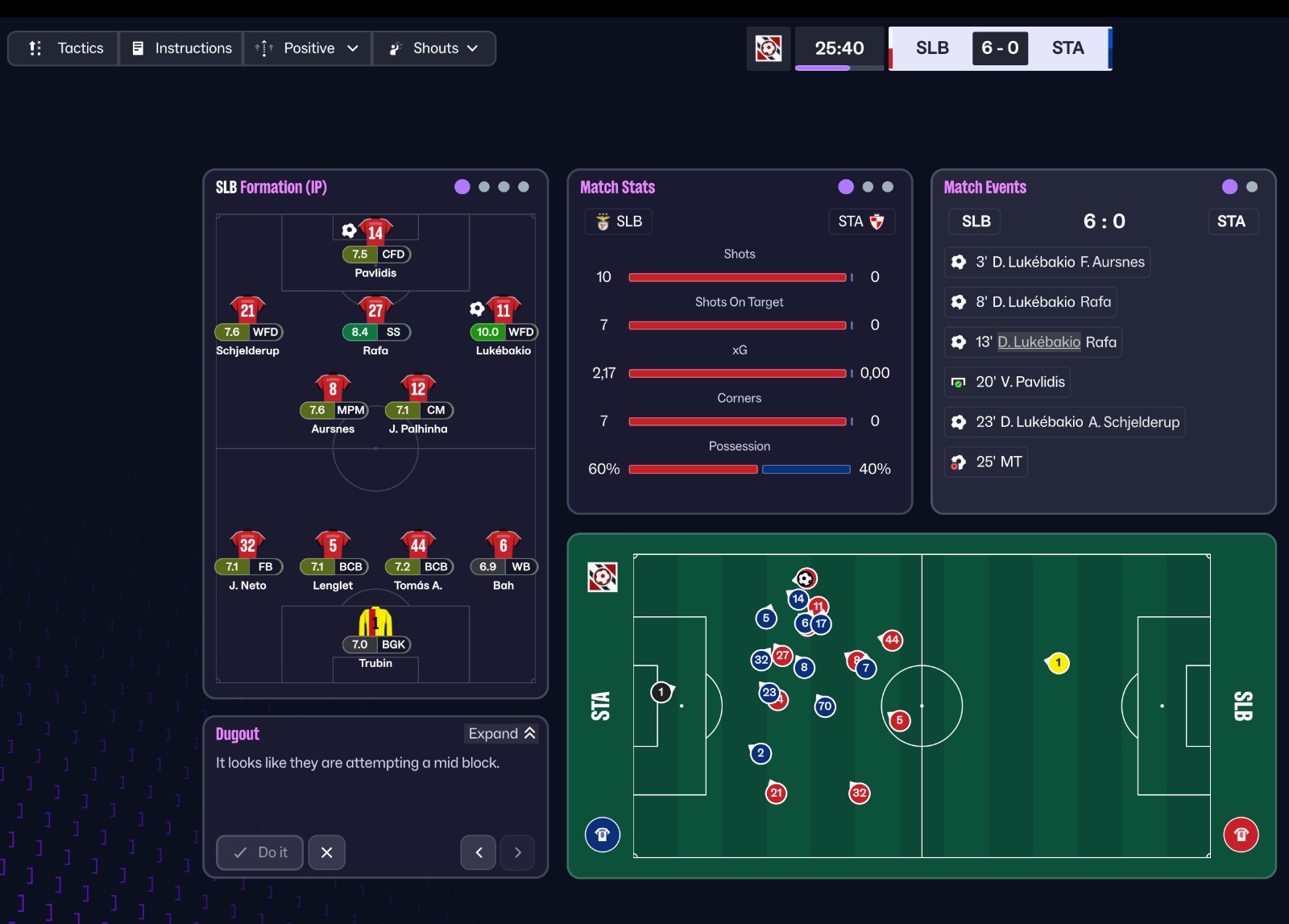
Wing-Backs at [2,5] and [2,1] providing width in transition.
4-3-3
Offensive shape with width from wingers and depth from midfielders.
Shadow Striker at [5,3] creating additional threat behind the lines.
Effective use of wing-backs creates space and stretches opposition.
WFD at [2,1] and WFD at [2,5] contribute to offensive width.
Strong central presence allows for quick transitions and ball retention.
MPM at [4,3] combined with a CM allows maintaining possession.
High defensive line may expose the backline to counter-attacks.
Much Higher Defensive Line position increases risk with swift opposition breaks.
Focusing on width can sometimes neglect central attacks.
Rafa's role as SS at [5,2] may lead to lack of support at certain moments.
Counter-Attacks
High positioning of wing-backs leaves space behind.
WBs at [2,1] and [2,5] vulnerable without adequate cover.
Central Pressure
Over-reliance on wide play can leave the midfield exposed.
Two CMs at [4,3] and [4,4] need assistance from the AM.
Mezzala and Shadow Striker
Creates overloads in the final third, increasing goal-scoring chances.
MPM at [4,3] supporting SS at [5,2] during attacks.
Wing-Backs and Wingers
Provides width and depth, stretching the defense.
WFD at [2,1/2,5] works well with W at [6,1/6,5] for overlapping chances.
How can adjustments to the defensive line enhance stability?
What changes can maximize offensive potential through central areas?
Would varying player roles improve adaptability during match play?
The tactical theory behind the 4-2-3-1 Wide: roles, instructions, and the trade-offs that decide whether the system holds up.
Double pivots and flat pairs in 4-2-3-1 and 4-4-2: when each pairing works, when it collapses, and the AMC unicorn that rescues both.
Klopp-style gegenpressing in FM, including squad profile, line-and-press pairing, sustainable workload, and the antipatterns to avoid.
What Higher Tempo, Wider, and Narrower actually do in FM, plus the dial contradictions and antipatterns players run into most often.