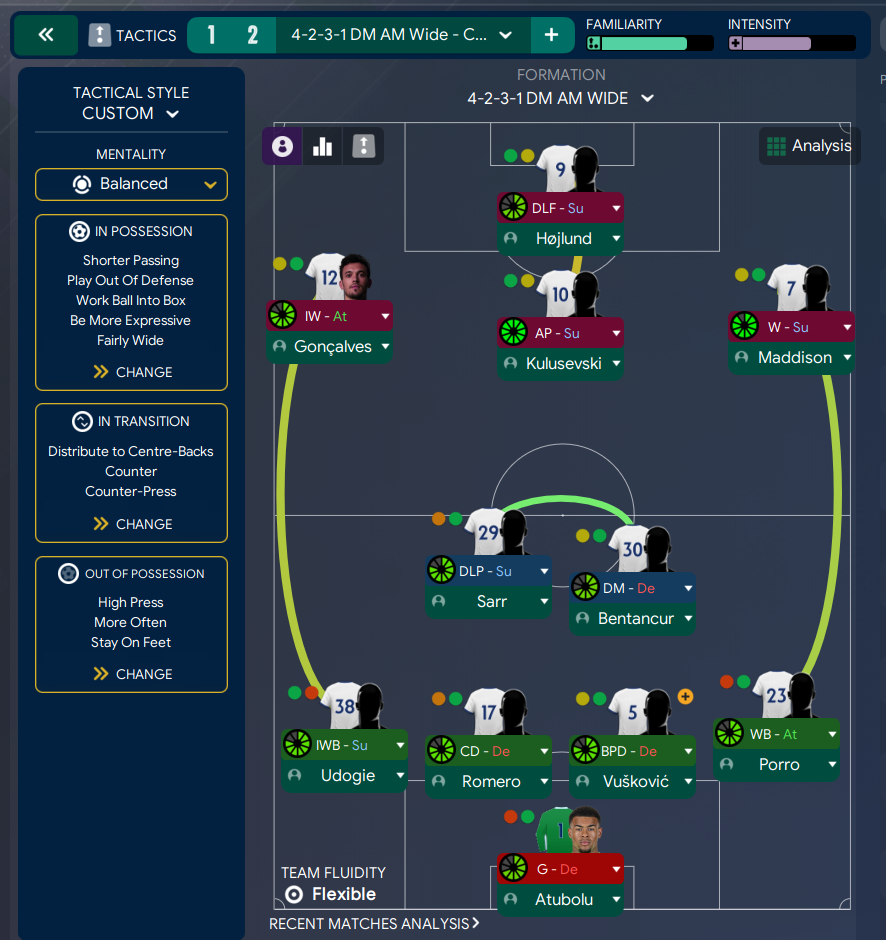
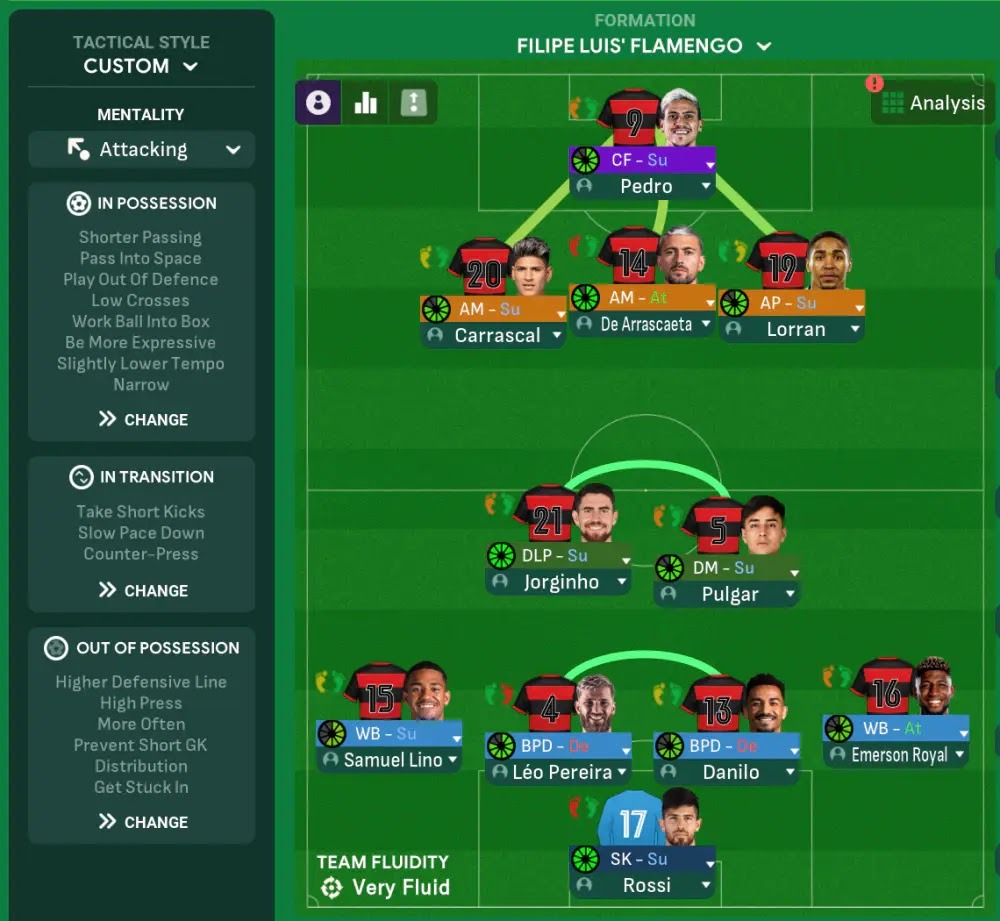
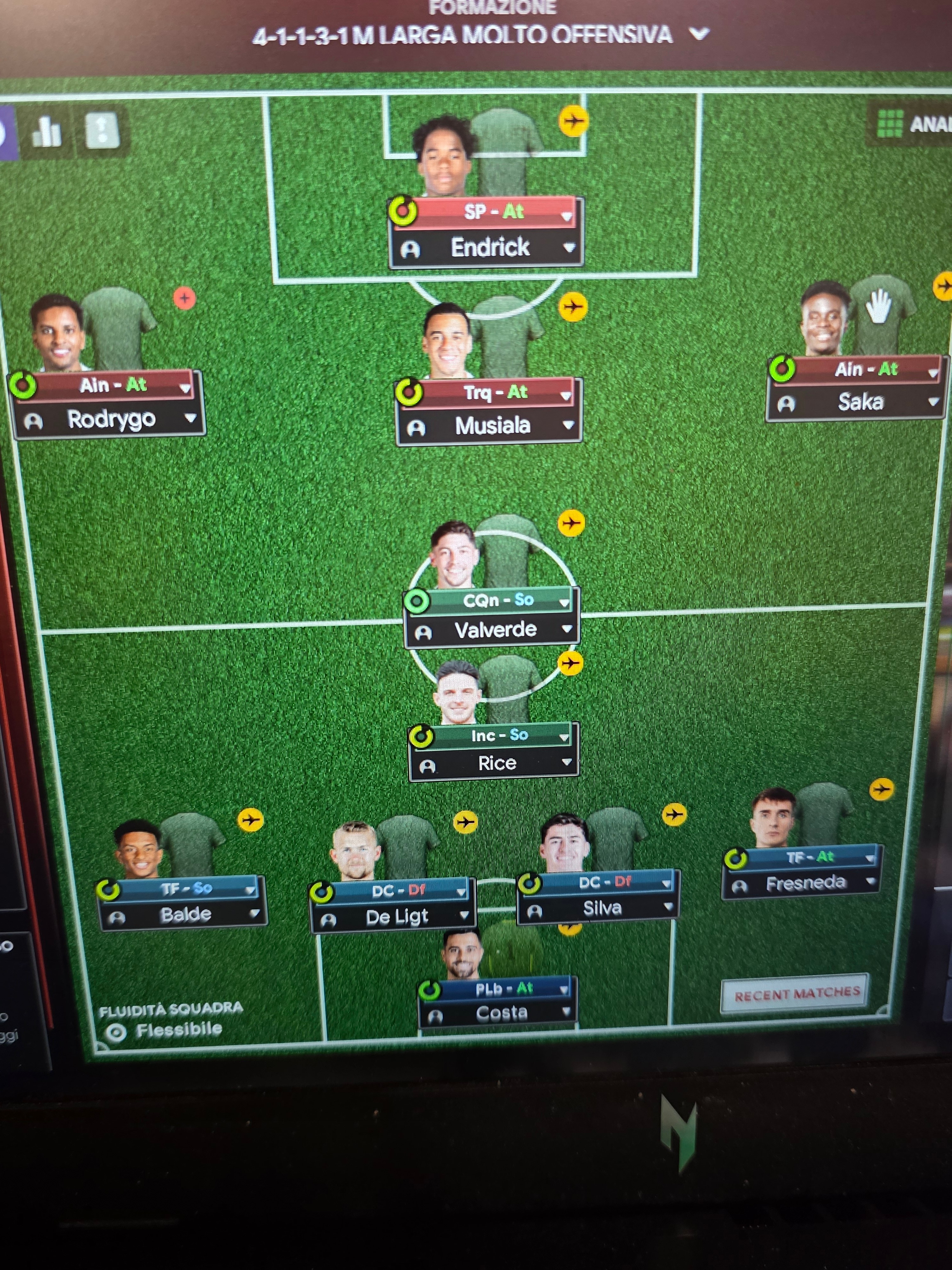
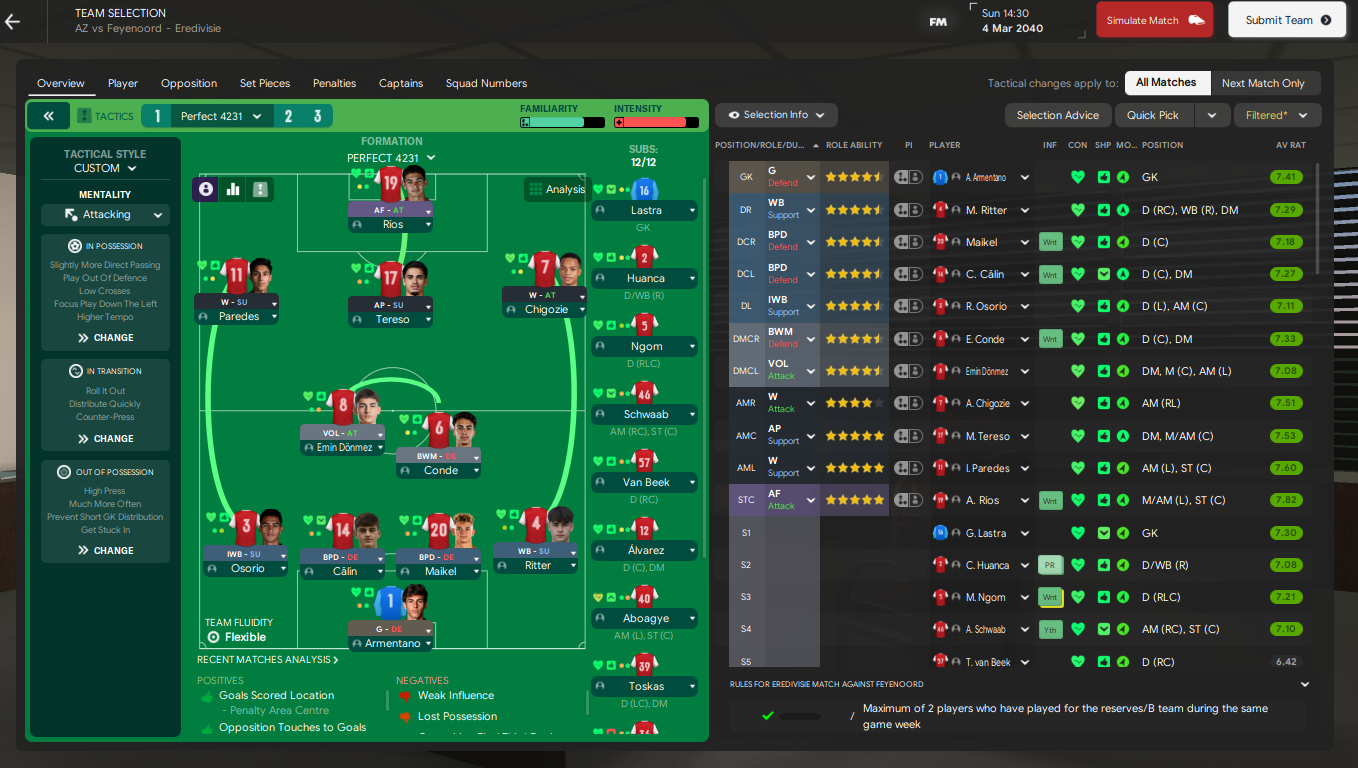
4-2-3-1
Building attacks through the midfield and wings. Multiple players in advanced positions enhance goal-scoring opportunities.
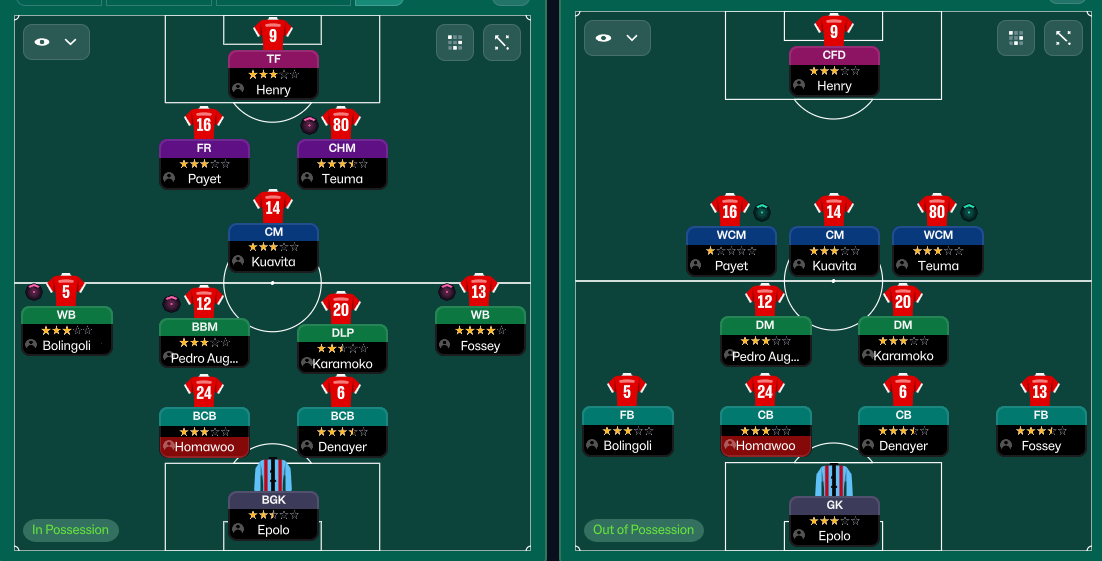
Loading tactical analysis...
Control
Positive
4-2-3-1
Organised
Play Out of Defence
Work Ball Into Box
Focus Play Down the Left
Counter-Press
Counter
Higher Line of Engagement
Standard Defensive Line
Prevent Short GK Distribution
GK
Goalkeeper
Defend
DL
Full-Back
Support
DC
Ball-Playing Defender
Defend
DC
Ball-Playing Defender
Defend
DR
Full-Back
Support
DM
Deep-Lying Playmaker
Support
DM
Ball-Winning Midfielder
Support
CM
Central Midfielder
Support
AMC
Shadow Striker
Attack
AML
Wide Playmaker
Support
AMR
Wide Playmaker
Support
ST
Complete Forward
Attack
Focuses on possession football with a solid structure, utilizing quick passing and overlapping runs.
Reorganizes quickly to apply pressure after losing possession.
Building attacks through the midfield and wings.
4-2-3-1
Compact structure, providing numerical superiority in midfield during defensive phases.
Two defensive midfielders (DMs) at [3,2] and [3,3] offer support to the back line.
4-2-3-1
Width provided by the wide players, allowing central players to exploit space.
Two wide playmakers (WCM) at [5,2] and [5,4] support the attacking dynamic.
Multiple players in advanced positions enhance goal-scoring opportunities.
Shadow Striker at [5,3] and two Wide Playmakers at [5,2] and [5,4].
Solid defensive structure with two strong defensive midfielders.
DM at [3,2] (Ball-Winning Midfielder) allows for robust defensive coverage.
High line of engagement may expose defense to quick counter-attacks.
Higher Line of Engagement combined with two less mobile DMs.
Heavy focus on wing play might lead to predictable attacks.
Three forwards rely on wide players to create opportunities.
Defensive Transition
Players may be caught out of position after a loss of possession.
Two high-engagement DMs may struggle to retreat quickly.
Wings
Heavy reliance on the wings may leave the middle open for opponents.
Two Wide Playmakers may pull defenders wide, opening central lanes.
Wide Playmakers and Central Midfielders
Promotes dynamic rotating plays between wide and central areas.
WCM at [5,2,4] and DLP at [3,3] can interchange effectively.
Ball-Winning Midfielder and Deep-Lying Playmaker
Combines defensive stability with creative play-making.
BWM at [3,2] provides cover for DLP at [3,3].
How can we adapt to counter-attacks more efficiently?
What adjustments can be made to enhance central attacking options?
Are there specific substitutions we should consider for tired players?
The tactical theory behind the 4-2-3-1: roles, instructions, and the trade-offs that decide whether the system holds up.
Double pivots and flat pairs in 4-2-3-1 and 4-4-2: when each pairing works, when it collapses, and the AMC unicorn that rescues both.
Klopp-style gegenpressing in FM, including squad profile, line-and-press pairing, sustainable workload, and the antipatterns to avoid.
Counter-Press, Regroup, Stand Off, Trigger Press: what each pressing instruction does in FM and how to pair them without contradicting.